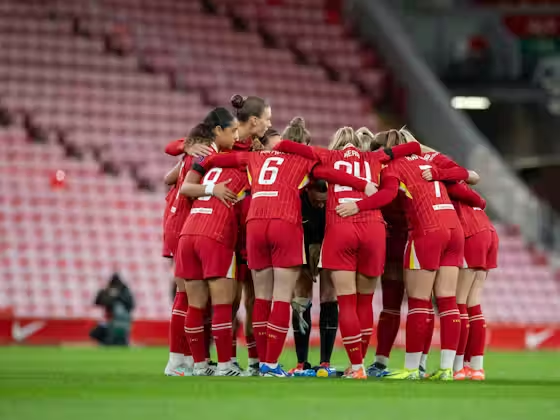
CREDIT: Insider Sport
The 2025/26 Women’s Super League (WSL) season is shaping up to be a transformative milestone for English women’s football – redefining the matchday experience, reshaping fan accessibility through groundbreaking media partnerships, and preparing for an era of expansion and innovation.
A Prime-Time Start for a Prime-Time League
On September 5th, Chelsea will host Manchester City under the lights, launching the new WSL campaign in style. But this isn’t just a season-opener – it marks the debut of a historic five-year domestic broadcast deal that puts the WSL front and centre like never before.
Cleverly scheduled during the first men’s international break, the WSL will command the football spotlight from 5–7 September. Every game from the opening weekend will be broadcast live – with coverage split across Sky Sports, the BBC, and YouTube – offering maximum visibility at a time when football fans are hungry for live action.
Saturday’s headline fixture sees Champions League winners Arsenal take on newly promoted London City Lionesses, while Sunday’s calendar features a Merseyside derby alongside Tottenham vs West Ham, Brighton vs Aston Villa, and Manchester United vs Leicester City – all scheduled for midday kick-offs.
The New Broadcast Era: Reach, Regularity, Ritual
At the heart of the WSL’s next chapter is a reshaped media strategy.
- Sky Sports has secured a dedicated Sunday 12pm slot, just ahead of its Premier League Super Sunday broadcasts. With a promise to air 118 matches per season (78 of which are exclusive), this gives the WSL a consistent, premium broadcast window.
- BBC will carry 21 matches annually – 14 on terrestrial television and seven on digital platforms like BBC iPlayer. Additionally, every WSL weekend fixture will feature local radio commentary and national audio coverage on BBC Sounds and Radio 5 Live.
The message is clear: women’s football isn’t being tucked away into off-peak slots or lower-tier digital channels. It’s being actively positioned within the heartbeat of British football culture.
A Bigger League is Coming
2025/26 will also be the last season the WSL operates with 12 teams. From 2026/27, the league will expand to 14 clubs – a move designed to boost competitive balance and long-term sustainability.
Alongside this, a new end-of-season relegation play-off will be introduced. Instead of automatic relegation, the bottom WSL club will face off against the third-placed team from WSL 2 in a one-off playoff to determine who earns the final spot in the top flight. It’s a shift that adds drama, stakes, and a fighting chance for both promotion and survival.
Alcohol in the Stands: A New Matchday Culture
Perhaps the most visible change for fans will be the full-season rollout of the alcohol-in-stands trial, which began last year on a limited basis.
This initiative is unique to women’s football. Unlike the men’s game, women’s matches are not bound by the 1985 Sporting Events (Control of Alcohol) Act, allowing fans to consume alcohol within sight of the pitch.
Following a highly successful pilot last season – involving over 50,000 fans across 19 matches – the trial will now expand to 14 clubs in both the WSL and WSL 2.
Participating venues include:
- Emirates Stadium (Arsenal)
- Kingsmeadow and Stamford Bridge (Chelsea)
- Goodison Park and Anfield (Everton and Liverpool)
- Hayes Lane (London City Lionesses)
- Joie Stadium (Manchester City)
- Leigh Sports Village and Old Trafford (Manchester United)
And in the second tier:
- Bristol City, Crystal Palace, Newcastle United, Sheffield United, Sunderland, Southampton, and Birmingham City.
The pilot was notable not just for fan satisfaction (66% supported it, with 48% strongly in favour), but for safety – no incidents were reported, and 84% of attendees rated their safety experience as 9 or 10 out of 10.
Holly Murdoch, Chief Operating Officer of WSL Football, noted:
“Expanding this trial for the new campaign, encompassing our Barclays WSL teams and additional Barclays WSL2 clubs too, is part of our strategy to offer a best-in-class experience for our fans attending matches.”
“Exploring giving supporters the choice to drink alcohol in the stands was something we were excited to trial and following such positive feedback from the proof-of-concept version, we’re looking forward to opening it up to more venues and equally, hearing from those at the heart of it – our clubs and supporters.”
By extending this fan-first initiative across key geographies – especially London and the North West – the league aims to embed a more relaxed, inclusive, and festival-like experience into the core of women’s football.
Why This Matters
The 2025/26 WSL season is more than a calendar of fixtures. It’s a redefinition of the product.
This is women’s football doubling down on its distinctiveness – not simply mirroring the men’s game, but carving out its own rituals, rhythms, and reach. With new clubs, new formats, and new freedoms for fans, the WSL isn’t just growing – it’s maturing.
And with better access through media and a more vibrant stadium experience, the path is clear: the WSL is evolving into one of the most commercially attractive and culturally relevant women’s leagues in the world.
Original reporting credit: Insider Sport
Partner With Us
Want to feature your brand, business, or service on 365247 — Whether you’re looking to sponsor, collaborate, or build presence within our ecosystem, we’d love to explore it with you.
Submit Your Interest Here