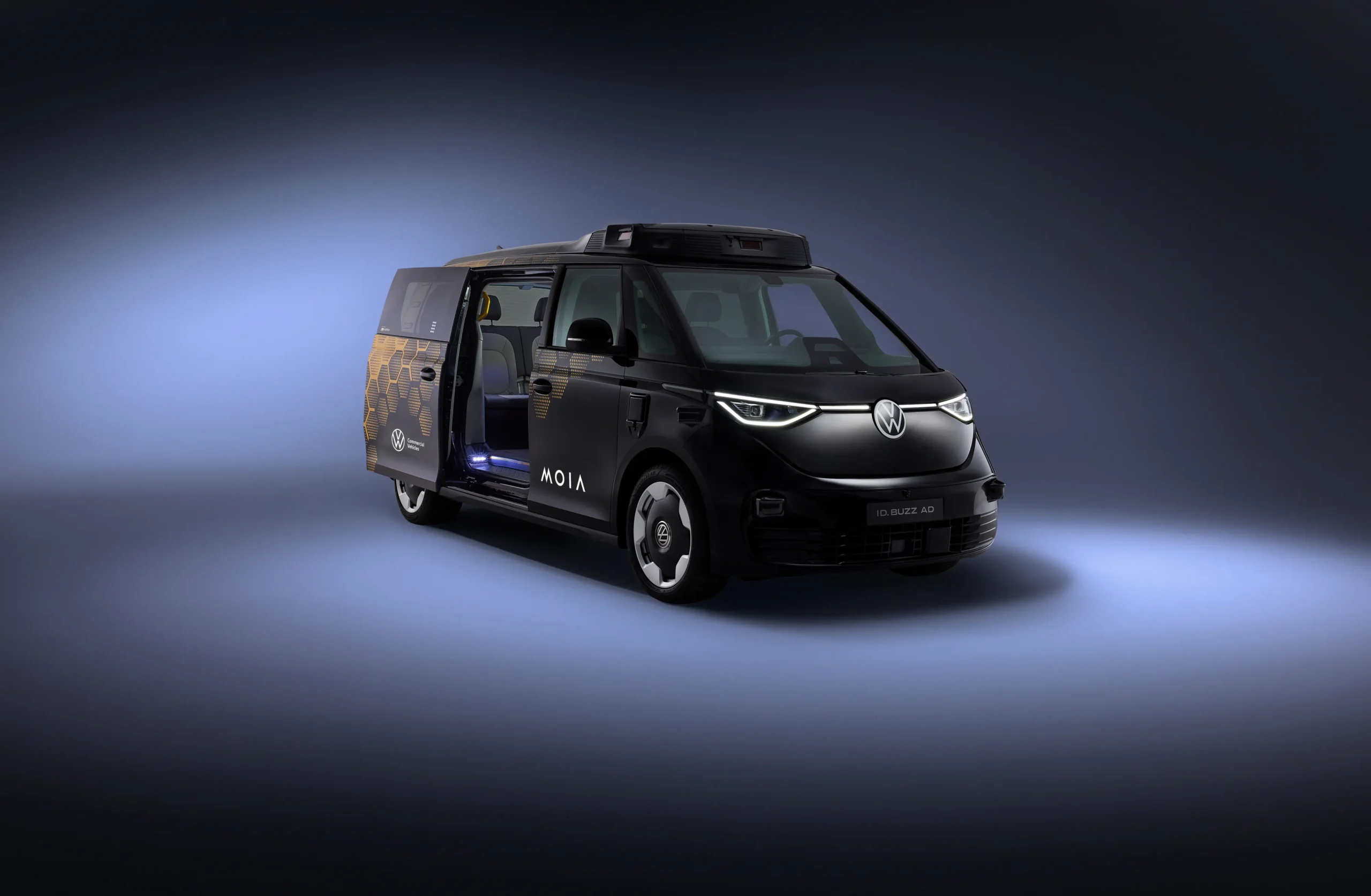
For a continent long seen as the gold standard in automotive engineering, Europe now finds itself scrambling to keep pace in one of the auto industry’s most disruptive frontiers: autonomous vehicles. And at the heart of this new charge is Volkswagen—with its electric ID.Buzz AV robotaxi leading the push.
The German automaker has begun real-world tests of its autonomous ride-sharing initiative in Hamburg, deploying a fleet of self-driving ID.Buzz minivans under the banner of its mobility brand MOIA. Equipped with an arsenal of sensors and co-developed with Intel’s Mobileye, the initiative represents Volkswagen’s clearest statement yet in its commitment to driverless transport.
But unlike the near-flawless operation of Waymo’s robotaxis in the U.S.—now conducting over 250,000 rides weekly—Volkswagen’s Hamburg pilot still requires backup human drivers and is limited to internal staff bookings. The company is aiming for broader public access in the coming months and plans to remove human safety drivers in Los Angeles by 2026, followed by Europe in 2027.
Europe’s Delayed Start in the Autonomous Race
While U.S. and Chinese firms have been testing driverless taxis for years in real-world settings, Europe has largely lagged. Stringent regulatory oversight, fragmented digital infrastructure, and the absence of platform-native tech giants have kept innovation slower on the continent.
That’s now changing. The European Union has launched a new action plan to revitalize its auto sector, including regulatory “sandboxes” and expanded testing environments for AVs. The push is as much about economic resilience—with the auto industry accounting for nearly 7% of EU GDP—as it is about catching up with geopolitical rivals.
From Hamburg to Hollywood: Volkswagen’s Dual-Continent Strategy
Volkswagen’s roadmap for the ID.Buzz AV is multi-pronged:
- Current Phase: Test mode in Hamburg with 30+ vehicles
- Next Step (2026): Launch in Los Angeles via a major partnership with Uber
- Mid-Term (2027): Rollout across European cities pending safety validation and regulatory alignment
Unlike competitors like Tesla—whose AV program has drawn criticism for erratic behavior—Volkswagen uses a full sensor stack that includes 13 cameras and 9 lidars. This hybrid approach allows for improved performance in adverse conditions such as rain, snow, and urban congestion. Safety drivers are currently stepping in to override the system when traffic rules or parked vehicles pose challenges the AI cannot yet navigate autonomously.
Cost-Efficiency Through Scale and Group Synergies
A key strength in Volkswagen’s approach is vertical integration and platform reuse. The robotaxi platform shares technology with Audi and Porsche, creating economies of scale for expensive hardware like lidars and onboard computing. Unlike Tesla’s camera-only vision or Waymo’s retrofit strategy, Volkswagen aims to manufacture autonomous-ready EVs directly on its production lines—lowering per-unit cost and accelerating commercialization.
That said, the automaker remains noncommittal on production targets. “We will scale at the speed of trust,” MOIA CEO Sascha Meyer emphasized—an acknowledgment of both the complexity of autonomous systems and the public trust they must earn.
Strategic Implications for Europe’s Mobility Sector
Volkswagen’s self-driving strategy is unfolding at a moment of tectonic change in global mobility:
- U.S. firms like Alphabet’s Waymo and Tesla are dominating the road miles and data collection race
- China is rapidly piloting robotaxis in dozens of cities with Baidu and others
- Europe, while behind, is leaning on regulatory clarity and manufacturing muscle to catch up
Additionally, tech players like London’s Wayve, backed by Uber and Softbank, are starting to roll out AV pilot programs of their own—most notably a planned robotaxi launch in London in 2026. The U.K. government is estimating that autonomous vehicles could contribute $58 billion to national GDP, underscoring the strategic weight of this sector.
What This Means for Cities, Investors, and Operators?
- City Planners
Municipal transport departments should view robotaxis not as competition, but as complements to urban mobility, particularly for underserved areas and off-peak hours. - Investors & Operators
Companies with strong manufacturing DNA and AV-ready infrastructure will hold an edge. Volkswagen’s approach could become a replicable template for other OEMs seeking relevance in an AI-first future. - Public Trust & Regulation
The real milestone won’t be software—it’ll be removing the backup driver. Public sentiment, insurance protocols, and incident transparency will determine how fast robotaxis go mainstream in Europe.
Final Word
Europe’s auto industry has always been synonymous with engineering excellence. But in the age of AI and autonomous mobility, software, sensors, and simulation are the new horsepower. With Volkswagen finally pushing the throttle on its robotaxi ambitions, the continent may have found its long-overdue ignition spark.
Join the 365247 Community here
IMAGE: Moia