In a defining moment for post-Brexit Britain and rising India, a landmark free trade agreement has been inked, promising significant export gains and strategic cooperation between the two nations. The long-anticipated pact, which took over three years to negotiate, signals a new phase of economic engagement—balancing market access, industrial synergy, and geopolitical alignment.
A Two-Way Trade Bridge
The deal provides mutual benefits: British cars, spirits, aerospace components, and healthcare devices will enter the Indian market with significantly reduced tariffs, while Indian exports like textiles, jewellery, and seafood become more competitive in the UK.
For British exporters, average tariffs to India will drop from 15% to just 3%, while whisky duties—once a staggering 150%—will be halved immediately, falling further to 40% by 2035. Indian firms, in turn, gain improved access to UK markets, including new pathways for electric and hybrid vehicles.
UK officials estimate the agreement could inject £4.8 billion into the British economy annually and support over 2,000 new domestic jobs. The deal also opens wider doors for Indian companies looking to expand their UK footprint.
Economic Diplomacy with Cultural Undertones
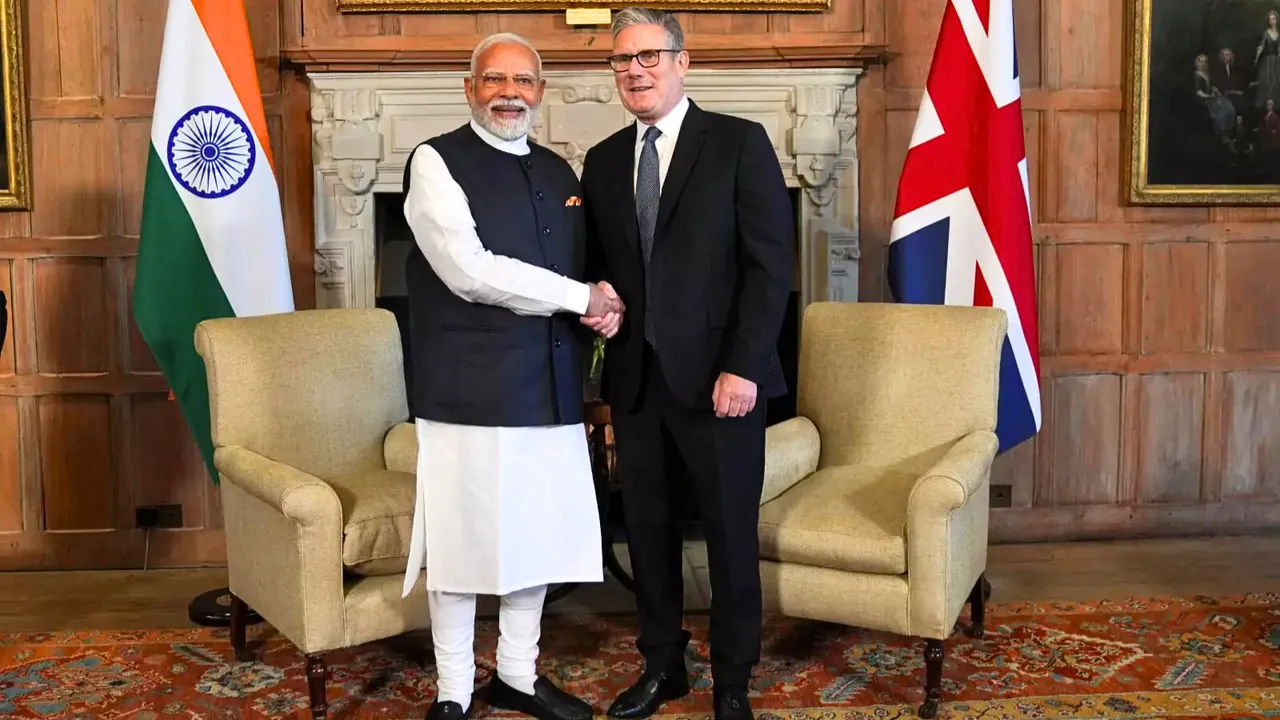
British Prime Minister Sir Keir Starmer and Indian Prime Minister Narendra Modi formalised the agreement during Modi’s visit to the UK, which included a meeting at Chequers and a symbolic tree-planting ceremony with King Charles at Sandringham—aligning economic diplomacy with soft power gestures and environmental consciousness.
Sir Keir described the agreement as the UK’s “most economically significant trade deal” since Brexit. “It shows Britain is serious about global trade again,” he said, adding that it reflects a broader ambition to deepen ties with nations that share historical, cultural, and commercial bonds with the UK.
Modi, for his part, called the pact a “blueprint for shared prosperity” and emphasised its potential to make high-quality UK products more affordable to Indian consumers while boosting Indian exports in advanced manufacturing and lifestyle sectors.
More Than Just Trade
Beyond commerce, the deal lays the foundation for closer collaboration in defence, education, climate change, and technological innovation. A proposed agreement on criminal data sharing aims to support legal enforcement and tackle illicit cross-border activity. Provisions around temporary worker transfers include reciprocal exemptions on social security contributions, echoing similar arrangements the UK has with several other major economies.
However, certain gaps remain. The UK had hoped for deeper access into India’s financial and legal services sectors, while India has voiced concern over UK proposals for carbon taxation. Both sides are continuing negotiations on a bilateral investment treaty to protect cross-border capital flows.
The Politics of Progress
While the agreement has been widely welcomed by the business community, it hasn’t been without criticism. Some UK opposition parties raised concerns about potential disadvantages for British workers and the extent of economic gain. Business Secretary Jonathan Reynolds dismissed these fears, stating unequivocally that there would be no cost advantage to hiring foreign workers over domestic talent.
Meanwhile, political reactions fell along expected lines. The Conservatives touted the deal as a “Brexit dividend” that Labour had merely signed off. The Liberal Democrats, in contrast, argued that closer EU ties would yield greater economic benefit in the long term.
The Global View
In an era of rising protectionism, this deal stands out for its pragmatism and potential. It positions the UK and India—both undergoing transformations in their global identities—as partners in a reshaped geopolitical order. As trade patterns shift and the Global South asserts greater agency, bilateral arrangements like this will play an outsized role in defining the 21st-century economy.
The agreement is expected to come into force in 2026 following UK parliamentary ratification.
365247 Media Insight:
This trade pact is not just a transactional success—it’s a geopolitical signal. For India, it further diversifies its strategic trade portfolio beyond China and the US. For the UK, it marks an attempt to reimagine its global influence post-EU. And for businesses on both sides, it’s a window of opportunity—one that rewards readiness, agility, and cultural fluency.
Partner With Us
Want to feature your brand, business, or service on 365247 — Whether you’re looking to sponsor, collaborate, or build presence within our ecosystem, we’d love to explore it with you.
Submit Your Interest Here