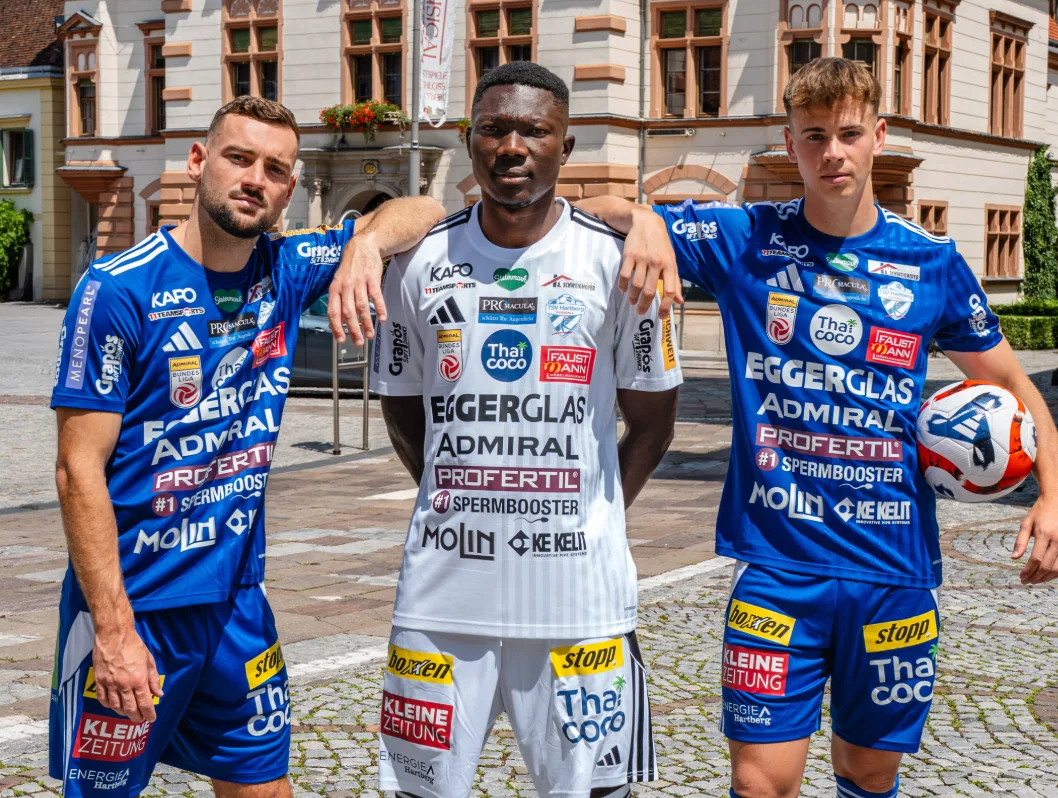
In an era where kit design is often a battleground between heritage and modern branding, Austrian club TSV Hartberghas once again decided to lean unapologetically into the latter. For the 2025/26 Austrian Bundesliga season, the club has unveiled a shirt that’s less about minimalist aesthetics and more about economic realism — reportedly featuring up to 20 sponsor logos.
This isn’t a one-off stunt. Hartberg embraced a similar approach last season with 19 brand placements on their matchday attire, spanning the chest, sleeves, and shorts. While it has drawn plenty of attention — and ridicule — on social media, the club is not only standing firm but doubling down on what some have called the “cycling jersey” model.
A Commercial Patchwork That Works
What may appear chaotic to design purists is, for Hartberg, a carefully calculated financial model. With a home base in a town of just under 7,000 residents, and with limited matchday or broadcast revenue, the club has turned to volume-based sponsorship as a sustainability tactic. Each logo, no matter how small, helps offset operating costs and secures Bundesliga-level competitiveness.
Club spokesperson Roland Puchas, speaking previously to local outlet Mein Bezirk, put it plainly: “We are very happy to have them [the sponsors]; without them, this [the Austrian Bundesliga] would not be financially possible.”
The key? Diversification. “We don’t want to become dependent on one sponsor like other clubs,” Puchas added. It’s a strategy aimed at resilience, spreading risk across multiple partners rather than leaning on one headline backer.
A Kit With Layers – And Local Power
One sponsor stands out — literally and symbolically. PROfertil, a male fertility supplement, not only features prominently on the kit but also lends its name to TSV Hartberg’s home stadium. The link runs deeper: the supplement is owned by Lenus Pharma, founded by club president Brigitte Annerl. It’s a hyper-local example of football and entrepreneurship intersecting — a rare case where the sponsor’s CEO is also at the helm of the club.
This blending of community, business, and sport underscores Hartberg’s identity: a club deeply rooted in its region but thinking unconventionally to compete nationally.
No Rules Broken – Just Expectations
While such visual branding excess might raise eyebrows elsewhere, the Austrian Bundesliga imposes no limit on the number of shirt sponsors. The only mandates relate to the visibility and positioning of competition insignia and player identifiers. So long as tobacco and similarly restricted products are avoided, the kit remains fully within legal bounds.
From a consultancy perspective, TSV Hartberg is deploying a micro-sponsorship model that flips traditional kit sponsorship hierarchies. While top-tier clubs chase eight-figure exclusivity deals, Hartberg opens its real estate to a wide base of brands, offering affordability and hyper-local alignment. It’s not just about commercial survival; it’s about accessibility for regional businesses to be part of top-flight football.
For smaller clubs in similar markets — be it in Eastern Europe, Scandinavia, or Southeast Asia — the Hartberg model is worth examining. It challenges the idea that commercial success must follow aesthetic trends, offering instead a blueprint for bottom-up brand aggregation.
It may not win design awards, but it just might keep a small-town club playing among Austria’s elite.
Partner With Us
Want to feature your brand, business, or service on 365247 — Whether you’re looking to sponsor, collaborate, or build presence within our ecosystem, we’d love to explore it with you.
Submit Your Interest Here