In a move that underscores shifting winds in the global auto industry, General Motors has announced a major production realignment that reemphasizes its commitment to internal combustion engine (ICE) vehicles — even as the industry at large wrestles with the pace of electric vehicle (EV) adoption.
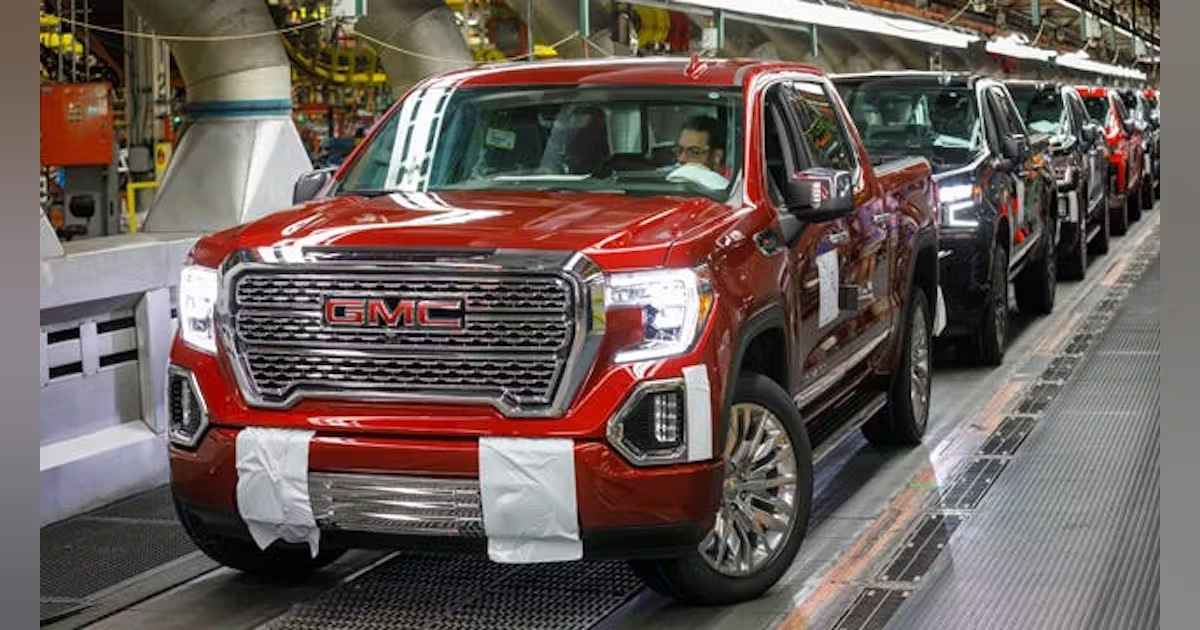
As part of a previously disclosed $4 billion investment across three U.S. facilities, GM will begin producing the Cadillac Escalade SUV at its Orion Township plant in Michigan, shifting it from its current location in Arlington, Texas. Alongside this, GM will also add production capacity for gas-powered Chevrolet Silverado and GMC Sierra light-duty pickup trucks at the same Michigan facility, supplementing existing operations in Fort Wayne, Indiana.
These models — full-size trucks and SUVs — continue to be among GM’s most profitable segments, representing the company’s financial backbone. Their expansion is being driven by what GM refers to as “continued strong customer demand,” despite broader narratives around a shift to electrification.
While the Arlington plant will continue producing large SUVs like the GMC Yukon, Chevy Suburban, and Tahoe, the strategic shift of the Escalade northward suggests GM is optimizing production geographically to create more capacity and flexibility in its core ICE portfolio.
Perhaps most telling is the shift in the timeline and use of the Orion Assembly facility. Originally slated to begin EV production in 2025, the Michigan plant will now launch production of gasoline-powered SUVs and pickups in early 2027. This represents a recalibration of EV expectations in the wake of softer-than-projected demand.
GM’s revised course raises questions around its previously stated target of ending gas-powered vehicle production by 2035. With these investments, the company appears to be hedging — ensuring ICE profitability while EV infrastructure and consumer appetite catch up.
Meanwhile, broader policy developments may be contributing to the pivot. The White House continues to push for domestic manufacturing with tariff pressures on imported vehicles, while recent legislation passed by Congress — and signed into law earlier this month — has significant implications. These include the removal of fines for missing Corporate Average Fuel Economy (CAFE) standards and the elimination of the $7,500 federal tax credit for EV purchases after September 30. Both developments potentially reduce the incentive — and the pressure — to scale EV production at speed.
GM previously paid over $128 million in penalties for CAFE violations tied to earlier model years. The rollback of such regulations, coupled with ongoing market hesitations around EV pricing, infrastructure, and range anxiety, suggests a more nuanced — and longer — path to electrification.
What This Means
General Motors’ latest manufacturing shifts are more than just plant updates — they represent a strategic rebalancing of the company’s near-term priorities. As the EV narrative matures from hype to execution, GM is betting that its traditional product lines will continue to deliver bottom-line value, even as it positions itself for a long-term transition to electric mobility.
In the race to the future, it seems GM is keeping one foot firmly planted in the present.