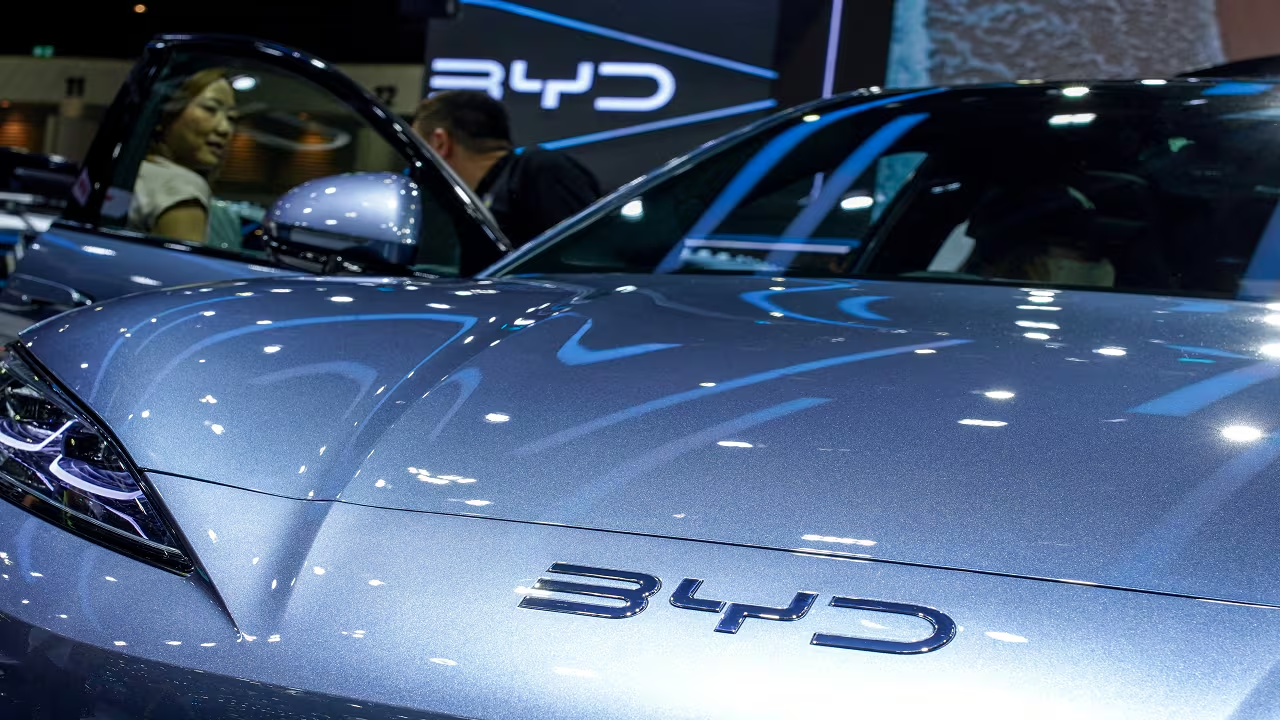
The battle for electric vehicle (EV) dominance has taken a sharp and dramatic turn. Tesla, long the global torchbearer for battery electric vehicles (BEVs), is now in a neck-and-neck race with Chinese juggernaut BYD. Once a quiet battery manufacturer, BYD has rapidly transformed into a vertically integrated EV powerhouse that is not only challenging Tesla but in many metrics, surpassing it.
Origins: Silicon Valley Tech vs Shenzhen Scale
Tesla and BYD both launched in 2003, but their paths diverged. Tesla grew from a Silicon Valley disruptor into a technology-first luxury car brand, releasing the Roadster in 2008 and the Model S in 2012.
BYD, meanwhile, was already building batteries and ICE vehicles. It launched its first plug-in hybrid in 2008 and its full-electric e6 in 2010. In 2020, it released the Blade Battery, and has since accelerated into the EV mainstream.
Sales Momentum: BYD Takes the Lead
While Tesla led BEV sales from 2018–2022, BYD has closed the gap and overtaken Tesla in new energy vehicle (NEV) sales. As of Q1 2025, BYD has sold over 1 million NEVs—416,000 of them fully electric—compared to Tesla’s slightly lower global output.
BYD’s annual revenue also overtook Tesla’s, reaching $107 billion compared to Tesla’s $97.7 billion.
Battery Innovation: Supercharging the Race
- Tesla: Emphasizes 4680 cylindrical cells for structural efficiency and energy density.
- BYD: Introduced the Blade Battery and now the 10C version, enabling 400 km of range in just 5 minutes of charge—a benchmark Tesla hasn’t matched yet.
Autonomy and Intelligence
- Tesla: Pursuing Level 4 autonomy using its Dojo supercomputer and FSD beta.
- BYD: Approaching Level 3 with technologies like LiDAR, HD mapping, and its proprietary DiPilot and God’s Eye systems. Premium models such as Denza N7 and Yangwang U8 are already close to autonomous readiness.
Manufacturing and Strategy
- Tesla: Operates gigafactories across the US, China, and Germany. Its vertically integrated supply chain ensures tight control and scalability.
- BYD: Maintains a China-centric manufacturing base but offsets this with diversification into batteries, chips, solar panels, and low-cost mass production.
Tesla prioritizes tech luxury and global presence. BYD wins on cost efficiency and adjacent sector integration.
Price Points and Market Access
| Brand | Model | Avg. Starting Price | Avg. Range | Market Position |
|---|---|---|---|---|
| Tesla | Model 3 RWD | $38,000 | 272 miles | Entry-level luxury EV |
| BYD | Seagull | $12,000 | 190-250 mi | Affordable urban EV |
Tesla is the premium choice; BYD dominates accessibility.
Policy Winds and Tariff Tensions
Regulations are reshaping competition:
- China: Offers dual subsidies, license plate advantages, and trade protections.
- USA: The Inflation Reduction Act (IRA) supports Tesla through domestic sourcing incentives.
- 2025 Update: The US imposed a 125% tariff on Chinese EVs; China retaliated. These escalating trade tensions will influence consumer pricing and global manufacturing strategy.
What Tesla vs BYD Teaches Global OEMs
This isn’t just a battle of brands—it’s a blueprint for EV ecosystems:
- Scale vs Software: BYD’s affordability model vs Tesla’s software-first DNA.
- Vertical Depth vs Vertical Integration: BYD spans across categories; Tesla keeps control in-house.
- Regulatory Alignment: Both tailor products to policy landscapes to optimize margins.