Source: ET Auto
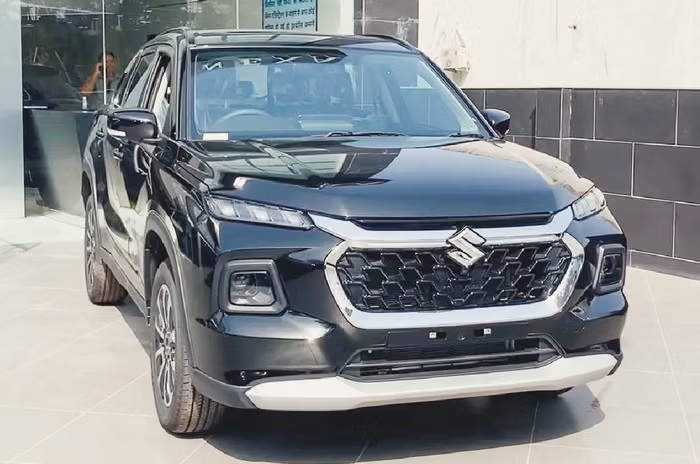
For the first time in over half a decade, India’s SUV market — long the darling of domestic car buyers — has hit a patch of deceleration.
In June 2025, SUV sales dropped 2.1% year-on-year to approximately 175,000 units, marking the segment’s first monthly decline since the pandemic-induced slump of 2020. This development signals a potential inflection point in a segment that has propelled the Indian passenger vehicle industry’s growth since FY2020.
What’s Behind the Slowdown?
Several overlapping factors seem to be at play:
- Macroeconomic pressures: Higher fuel prices and economic uncertainty are weighing on consumer sentiment.
- IT sector turbulence: Layoffs in key white-collar sectors, especially IT, are impacting urban discretionary spending.
- Saturation risk: With SUVs now accounting for a significant share of new car sales in India, demand may be plateauing in some metros.
- High base effect: After several years of blistering double-digit growth, any slowdown appears more pronounced in contrast.
Contextualizing the Numbers
- FY2022: +42% growth in SUV sales
- FY2023: +36%
- FY2024: +27%
- FY2025: +11.3%
- Q1 FY2026: +5.6%
According to Ravi Bhatia, President of JATO Dynamics, “Monthly sales data for 2025 reveals a marked and consistent decline in SUV sales between January and June… this appears to be the first prolonged downturn in SUV demand since the pandemic.”
Where Is the Demand Moving?
With SUVs cooling off, Multi-Purpose Vehicles (MPVs) may be stepping into the limelight. Industry observers suggest that consumers are gravitating towards more utilitarian, family-first models — especially in Tier II and Tier III cities — indicating a potential pivot in preferences. MPVs, once considered outdated, are now regaining ground, thanks to refreshed styling, better mileage, and ride comfort.
Strategy Moves for Automakers
If this isn’t a blip but the beginning of a structural recalibration, how should OEMs respond?
1. Redefine Product Mix
Brands heavily dependent on SUV volume must re-evaluate their launch pipelines. A more balanced mix, with MPVs and compact crossovers at the core, could safeguard margins and volume.
2. Segment-Specific Innovation
As urban centres saturate, rural and semi-urban markets remain ripe for affordable SUVs and MPVs with high fuel efficiency, flexible financing, and digital-first retail models.
3. Demand-Driven Localization
With fuel and macro pressures at play, hybrid or electric variants in the compact SUV/MPV space could find favour — especially with state-backed incentives.
4. New Messaging for MPVs
The rise of the Indian nuclear family and shared mobility ecosystems could make MPVs aspirational again — but this requires repositioning the category with lifestyle-driven narratives, not just practicality.
5. Data-Led Pricing and Incentive Structures
OEMs need to lean into advanced analytics to deploy regionalised pricing strategies that adjust to local demand and sentiment — especially with growing inventory pressure.
Final Word
A single month doesn’t make a trend — but six months might. With SUV sales softening, the Indian auto market may be entering a new phase of maturity. For automakers, agility in product strategy and demand forecasting is more critical than ever.
Partner With Us
Want to feature your brand, business, or service on 365247 — Whether you’re looking to sponsor, collaborate, or build presence within our ecosystem, we’d love to explore it with you.
Submit your Interest Here