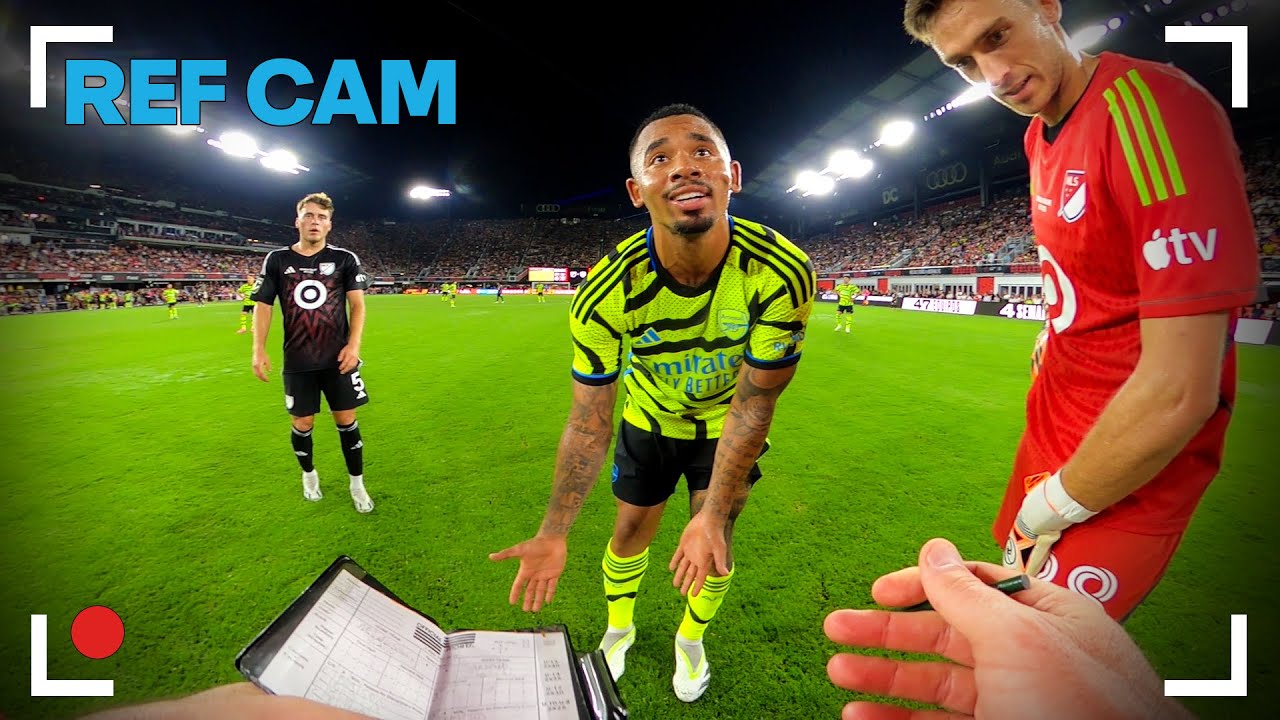
Referee-mounted cameras (RefCam) have crossed the line from novelty to production tool. They change what fans see, how producers tell stories, how sponsors activate, and how leagues talk about officiating. With IFAB broadening trials after FIFA’s Club World Cup tests and top leagues moving from pilots to on-air use, RefCam is becoming part of football’s next broadcast stack.
What RefCam Actually Is (and Why It’s Different)
Unlike shoulder-mounted or steadicam shots, RefCam captures a decision maker’s field of view in real time: distance to contact, angles through traffic, and sightlines around bodies. In Germany, the DFL introduced RefCam during 2023–24 test matches and then used it in the Bundesliga in February 2024 with FIFA referee Daniel Schlager—after coordination with IFAB, DFB Schiri GmbH, and the clubs.
By early 2025, the Bundesliga had framed RefCam as part of its toolkit to deepen understanding of decisions and enrich the viewing experience.
Technically, the stack is maturing fast. Riedel’s RefCam Live has delivered 1080p50 from the referee’s eye level and proven end-to-end transport over private 5G during Der Klassiker—a blueprint for low-latency, broadcast-grade POV.
Why This Matters Now
- Regulatory tailwind: IFAB approved an extension of broadcast body-cam trials beyond FIFA tournaments to domestic and international competitions, opening the door for leagues and broadcasters to test and learn.
- Production readiness: The Bundesliga has taken RefCam from pilots to live usage, pairing it with broader transparency upgrades (e.g., stadium referee announcements rolling out league-wide in 2025–26).
- Audience impact: POV moments go viral and create explainers for officiating. They also enable new replay language: “what the ref actually saw,” not just what a gantry lens captured.
The Premier League: From Experiment to On-Air
- First steps: Jarred Gillett wore a head-mounted cam for Crystal Palace vs Manchester United (May 2024). The footage wasn’t live but was later released by the Premier League—proof of concept for education and storytelling.
- Authorization & planning: After IFAB’s expanded trial approval, the Premier League entered talks to introduce RefCam, with reports of tests targeted around season start.
- On-air trial: Multiple outlets reported Premier League broadcasts integrating RefCam in August 2025, with a high-profile moment: Dominik Szoboszlai’s long-range free-kick captured from the referee’s POV—a showcase of how compelling (and viral) the angle can be.
- UX watch-outs: Early viewer feedback has included praise and some motion-sickness complaints—the latter a known risk with fast, head-mounted POV that producers will need to manage with clip length, stabilization, and selective use.
- Stadium integration: Reports indicated the league’s intent to display RefCam clips on big screens following trials in the Summer Series—bridging broadcast and in-venue experience.
Seven Use-Cases That Go Beyond “Cool Angle”
- Officiating literacy & trust
Side-by-side: broadcast feed vs. RefCam in critical calls (contact, obstruction). Fewer abstract debates—more context for what the official actually saw. (Bundesliga’s transparency arc—RefCam plus in-stadium explanations—points the way.) - Micro-storytelling for social
8–12-second “Ref POV” shorts around set pieces, melees, and counters; ideal for reels and broadcaster apps. (Premier League’s Szoboszlai clip exemplifies the format’s virality.) - VAR education
Producer’s telestration that shows the ref’s line, the VAR line, and the outcome—turning controversy into explainers fans can share. - Second-screen interactivity
Opt-in RefCam tiles in OTT apps for key moments (not entire matches), with user-adjustable stabilization to mitigate motion discomfort. - Coaching & elite development content
Curated libraries of RefCam incidents for referee training; IFAB’s green light enables systematic capture for performance programs. - Sponsorship units
Branded “From the Ref’s View” segment stings and midweek analytical shorts. Sell units, not static inventory. - Eventization
Cup rounds, derbies, and international tours as RefCam showcase windows—time-bounded, heavily marketed, and measured for uplift.
Production & Policy Realities (and How to Handle Them)
- Latency & reliability: Private 5G and bonded transmission (as used in Germany) are key to clean handoffs to the truck. Back-up paths and aggressive QC matter for a camera that’s always in motion.
- Shakiness & comfort: Use RefCam in moments, not as a primary camera. Stabilize, cut quickly, and never hold long shots during end-to-end transitions. Early PL feedback underscores the need for editorial restraint.
- Privacy & consent: Clear frameworks for on-pitch audio (often disabled at first), tunnel/touchline zones, and what gets published later.
- Competition integrity: IFAB permission remains essential, and leagues should coordinate with officiating bodies (e.g., PGMOL/DFB) to define what’s live, delayed, or training-only.
- Grassroots vs. broadcast: Remember that IFAB’s grassroots body-cam trials are primarily about deterring abuse; broadcast body-cams serve a different objective and must be governed separately.
The Bundesliga’s Blueprint
Germany’s pathway—early trials, a first live Bundesliga use in Feb 2024, explicit positioning around fan understanding, and 2025–26 expansion of referee announcements—shows how to build acceptance step by step. The Der Klassiker 5G deployment proves the transmission model scales for Tier-1 matches.
The Premier League’s Opportunity
The PL has the audience and the broadcasters to turn RefCam into a packaged product:
- Editorial playbook: Use sparingly for high-impact replays (set-pieces, box incidents) and educational segments in post-match shows.
- Venue tie-in: Short clips on big screens to “explain the call,” matching broadcast with stadium experience (as reported around Summer Series trials).
- Rollout logic: Keep August–September as a soft launch window, evaluate comfort/complaints, then scale during tent-pole fixtures. News coverage already documents both fan excitement and motion-comfort concerns—measure, iterate, and formalize best practices.
Measurement: Prove It or Lose It
KPIs to track by matchweek:
- View-through rate for RefCam clips vs. standard replays
- Social saves/shares of “ref POV” explainers
- Complaint rate (motion sickness, confusion) per 10,000 viewers
- RefCam-adjacent sponsor recall vs. control
- VAR sentiment change (pre/post RefCam era) in fan panels
Make RefCam a System, Not a Stunt
For leagues & federations
- Policy & permissions — IFAB compliance, audio rules, data retention, and a league-wide editorial charter that defines when/how RefCam is used. theifab.com
- Broadcast integration — Vendor RFPs (e.g., private-5G and POV systems), truck workflows, stabilization standards, clip taxonomies, and rights packaging. TVBEurope
- Transparency stack — Pair RefCam with referee announcements (Bundesliga model) and next-day explainers to measurably lift officiating trust. DFL Deutsche Fußball Liga GmbH – dfl.de
For clubs
4) In-venue UX — Safe use on big screens (no long shaky cuts), with simple explainer graphics when showing contentious calls. Irish Examiner
5) Social product — A weekly “From the Ref’s View” series across languages; creator partnerships to interpret moments for casual fans.
For sponsors & brands
6) Own the angle — Branded “Ref’s View” idents, midweek breakdowns, and premium slots on OTT angle-chooser surfaces. Sell outcomes (attention, saves, shares), not raw impressions.
For officiating bodies
7) Performance & education — Build an internal RefCam library to coach positioning and decision pathways; publish a small, fan-facing slice to humanize officials.
The Bottom Line
RefCam is not about gimmicks. It’s about context—showing fans what officials actually see—while giving broadcasters a new grammar for replays and giving sponsors premium, high-intent moments. The tech is ready; the policy lane is open; and early broadcasts have already produced iconic clips that traditional cameras couldn’t.