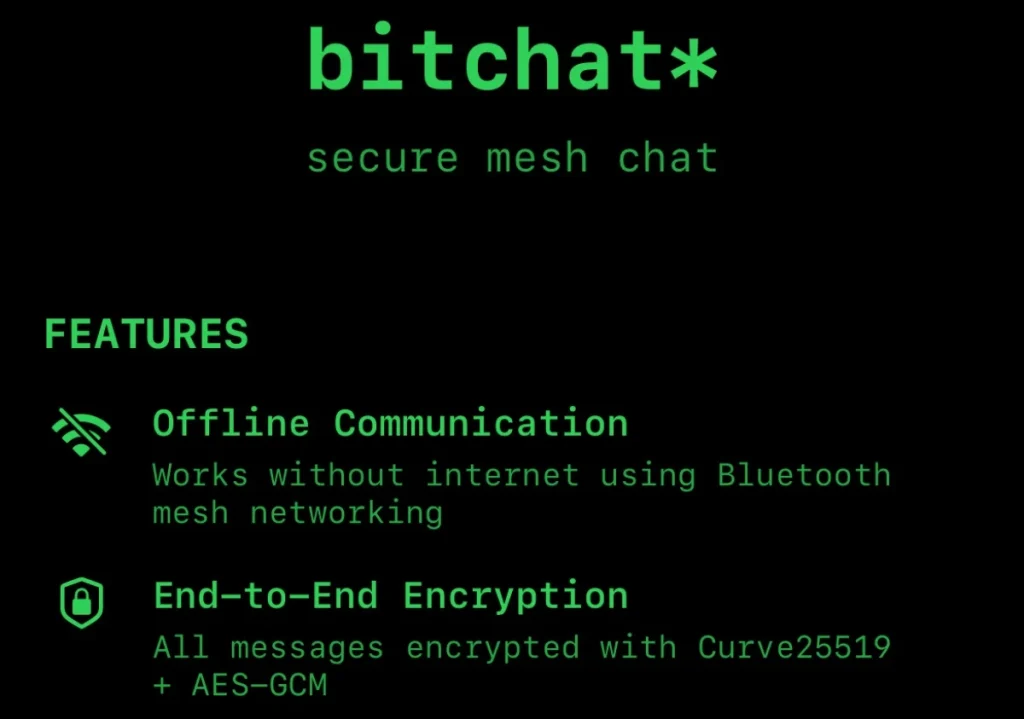
Jack Dorsey, the tech visionary behind Twitter and CEO of fintech firm Block, has introduced a radical new messaging platform—Bitchat—designed to function entirely off-grid. The app enables users to exchange encrypted messages without internet access, cellular networks, or even user accounts.
Described as a personal experiment, Bitchat is currently in beta and available via Apple’s TestFlight platform. Dorsey announced the release on X, emphasizing its exploration of Bluetooth mesh networking, encryption models, and communication protocols resilient to censorship and infrastructure failure.
Decentralized Messaging in Action: How Bitchat Works
Bitchat operates through Bluetooth Low Energy (BLE) mesh networking, meaning messages are passed directly between nearby devices. If two users are within approximately 300 meters, they can communicate directly. More importantly, messages can be relayed via other users—even if they’re out of direct range—creating a fluid, peer-to-peer network without reliance on servers or the cloud.
This infrastructure-free communication method is similar to tools used during the 2019 Hong Kong protests, where protestors relied on mesh networks to evade internet blackouts and surveillance.
Key features include:
- No central server
- No accounts or phone numbers
- End-to-end encryption
- Temporary messages stored only on devices
- Password-protected group chats
- Support for delayed delivery when users go offline
- Planned support for WiFi Direct
Part of a Bigger Vision: Dorsey’s Push Toward Digital Autonomy
Bitchat is not an isolated experiment. It joins a growing list of projects from Dorsey focused on privacy-first, decentralized ecosystems, including the social app Damus and the Bluesky protocol. All aim to minimize reliance on Big Tech intermediaries and promote user sovereignty over personal data.
In a technical whitepaper released alongside the app’s beta, Bitchat is described as “a peer-to-peer messaging application that operates over Bluetooth Low Energy mesh networks… designed to be resilient to network outages and censorship.” Within hours of its announcement, the beta version’s 10,000 test slots were filled.
Dorsey also made the source code public via GitHub, inviting developers to participate in building out the Bitchat protocol, which he humorously referred to as “ugly but necessary.”
At 365247 Media, we view Bitchat as a compelling case study in how decentralized technology is reshaping modern communication infrastructure. Beyond its technical novelty, Bitchat represents a strategic pivot toward platforms that:
- Prioritize individual privacy
- Bypass traditional telecom and internet dependencies
- Respond to emerging geopolitical and disaster scenarios
For governments, NGOs, and global businesses operating in high-risk or low-connectivity zones, this kind of technology opens doors to resilient crisis communication models. For consumers and developers, it signals a shift toward messaging platforms built not around monetization, but autonomy.