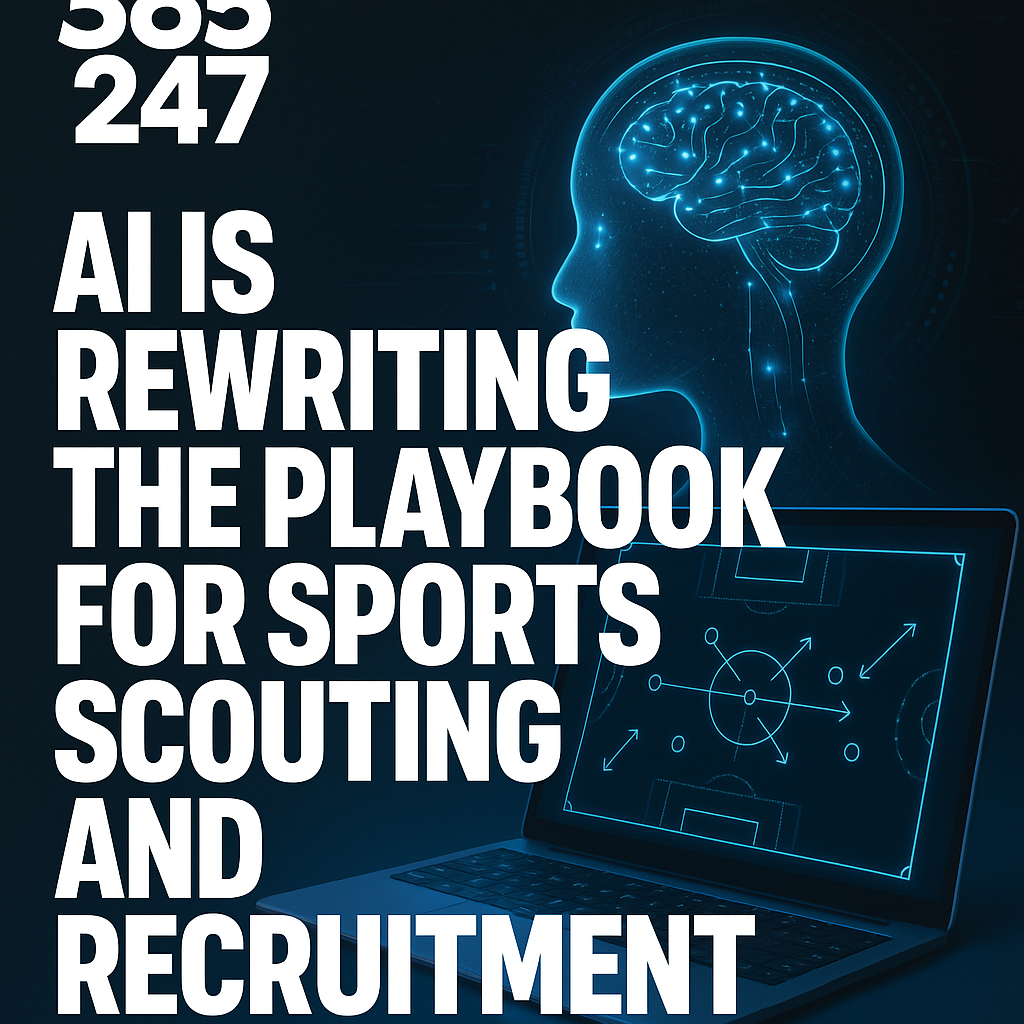
The world of sports scouting and recruitment is in the middle of its biggest transformation in decades. What once depended almost entirely on the intuition of scouts, gut feeling, or basic statistical analysis is now being reshaped by artificial intelligence (AI). From spotting undervalued talent to predicting injuries before they happen, AI is unlocking new ways for teams to build smarter, more sustainable rosters.
1. Enhanced Data Analysis: Beyond the Box Score
Traditional scouting was built on simple stats — goals, assists, batting averages. AI has taken this several levels higher. By aggregating and analyzing data from player tracking systems, biometric wearables, performance metrics, and even social media sentiment, clubs can now build a 360-degree profile of an athlete.
Key data points include:
- Physical performance and technical skills
- Tactical awareness and adaptability
- Psychological resilience
- Injury history and recovery patterns
- Public image and fan perception
This holistic approach reduces the risk of bias and ensures that hidden talent is less likely to slip through the cracks.
Case in point: A Premier League club used AI to spot an undervalued midfielder in Belgium. His ability to make decisions under pressure was flagged by AI models, leading to a transfer worth £8m. Eighteen months later, he was valued at £45m.
2. Automated Video Analysis: Seeing the Unseen
Manually reviewing video footage is time-consuming. AI-driven computer vision now processes hours of match footage in minutes, tagging every pass, movement, and decision with precision.
Capabilities include:
- Automated event tagging
- Benchmarking players against peers
- Tactical analysis in real time
- Generating highlight reels for scouts and coaches
Ajax’s youth academy has pioneered this system, reducing scouting time by 70% while improving talent identification accuracy by 45%.
3. Predictive Analytics: Spotting Tomorrow’s Stars
AI doesn’t just assess today’s ability — it predicts tomorrow’s potential. By analyzing performance trajectories and contextual data, predictive models can identify players set to break out before the market recognizes their value.
Example: Borussia Dortmund’s system highlighted Erling Haaland’s goal-scoring potential when he was still in Norway. That insight led to a €20m signing that quickly turned into one of the best investments in European football history.
4. Injury Prediction and Prevention
Player health is as much a financial issue as it is a sporting one. AI monitors workload, biomechanics, and recovery to predict injury risk with up to 90% accuracy.
FC Barcelona reduced muscle injuries by 50% after deploying an AI-driven system that adjusted training loads in real time. Protecting players means protecting club investments.
5. Personalized Player Development Plans
Every athlete has a unique profile. AI can now generate training plans tailored to each player’s needs, from technical drills to nutrition and mental resilience.
Ajax’s academy uses AI to track over 200 performance indicators and create adaptive training schedules — a key reason it continues to produce world-class talent at scale.
6. Opposition Analysis and Strategy
AI gives coaches the power to analyze opponents in unprecedented detail. From formation shifts to pressing triggers, clubs can now design tactical blueprints informed by thousands of hours of automated analysis.
Liverpool’s gegenpressing system benefited heavily from AI insights that revealed opponents’ vulnerabilities under pressure, directly contributing to Champions League and Premier League titles.
7. Scouting Network Optimization
Instead of casting a wide net, AI helps clubs target specific regions and leagues where undervalued talent is most likely to emerge. Leicester City’s discovery of Riyad Mahrez from France’s second tier — bought for £400k, sold for £60m — illustrates the return on smart scouting investments.
8. Smarter Contract and Transfer Decisions
AI models analyze wage structures, resale value, and performance curves to ensure clubs avoid costly mistakes. Clubs like Brentford have built their reputations on “Moneyball”-style efficiency, consistently finding undervalued talent that generates massive ROI.
9. Psychological and Cognitive Profiling
Performance isn’t just physical. AI is beginning to assess decision-making under pressure, leadership potential, and resilience — giving clubs a clearer view of whether a player has the mentality to succeed at the highest level.
The Future of Scouting: AI as the Competitive Edge
The role of scouts and coaches is far from obsolete, but it is being fundamentally reshaped. AI provides depth, consistency, and foresight that humans alone cannot match. The winners in this new era will be clubs that balance data-driven intelligence with human intuition, ensuring that every decision — from youth recruitment to multi-million-dollar transfers — is informed by both science and experience.
AI is not just a tool. It is becoming the foundation of how modern clubs will compete in the global talent marketplace.