Honda Motorcycle & Scooter India (HMSI) has laid out an ambitious roadmap to expand its footprint in one of the world’s most competitive two-wheeler markets. The company is aiming for a 30% market share in India by 2030, a strategic leap from its current 27% — signaling its intent to play a central role in India’s evolving mobility story.
This expansion isn’t just about volume — it’s about diversifying demand and preparing for future technologies.
Unlocking Untapped Potential: Women Riders in Focus
India’s two-wheeler segment has traditionally skewed heavily male, with women making up only about 10% of riders. Honda sees this imbalance not as a market limitation, but a significant growth lever — one that aligns with rising female workforce participation and growing urban independence.
This demographic shift could unlock a new consumer base, especially in urban and peri-urban centers where two-wheelers offer both mobility and affordability.
Global Synergies, Local Strategies
Honda’s push in India is part of a broader global objective: achieving 50% of global two-wheeler sales from EVs by 2030. For a brand that already commands 80% market share in ASEAN, India is being treated not just as another volume market, but as a strategic testbed for product diversification.
With retail sales crossing 4.7 million units in FY25, HMSI remains the second-largest player in India, trailing only Hero MotoCorp. Honda’s ability to bridge performance, affordability, and technology will be key as competition intensifies — especially in the electric segment.
EV Ambitions Meet Ground Realities
Honda has publicly committed to launching 30 electric motorcycle models globally by the end of the decade, with 4 million units in annual EV sales as a target. In India, it plans to establish a dedicated electric two-wheeler manufacturing facility by 2028 — though specifics on location and capital investment are yet to be disclosed.
However, scaling electric mobility in India will not be without its hurdles. Infrastructure gaps — from charging networks to power grid reliability — remain serious challenges. Honda appears aware of these structural barriers, balancing long-term EV ambition with a near-term focus on flex-fuel and transitional technologies.
The India Playbook is Expanding
Honda’s evolving India strategy reflects a layered understanding of both market potential and constraints. By targeting women riders, localising product portfolios, and planning EV investments, Honda is positioning itself not just for market share, but for long-term strategic relevance in India’s transport future.
This is not just a sales plan. It’s a transformation blueprint.
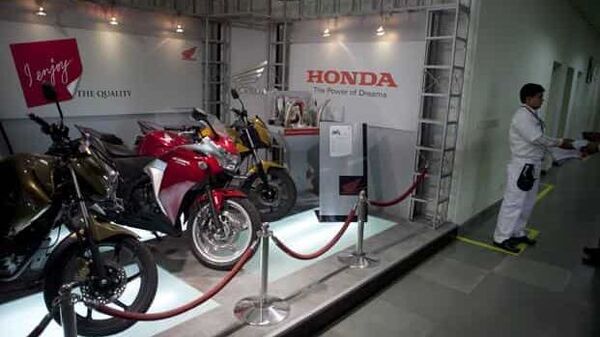
IMAGE: Bloomberg