The headline
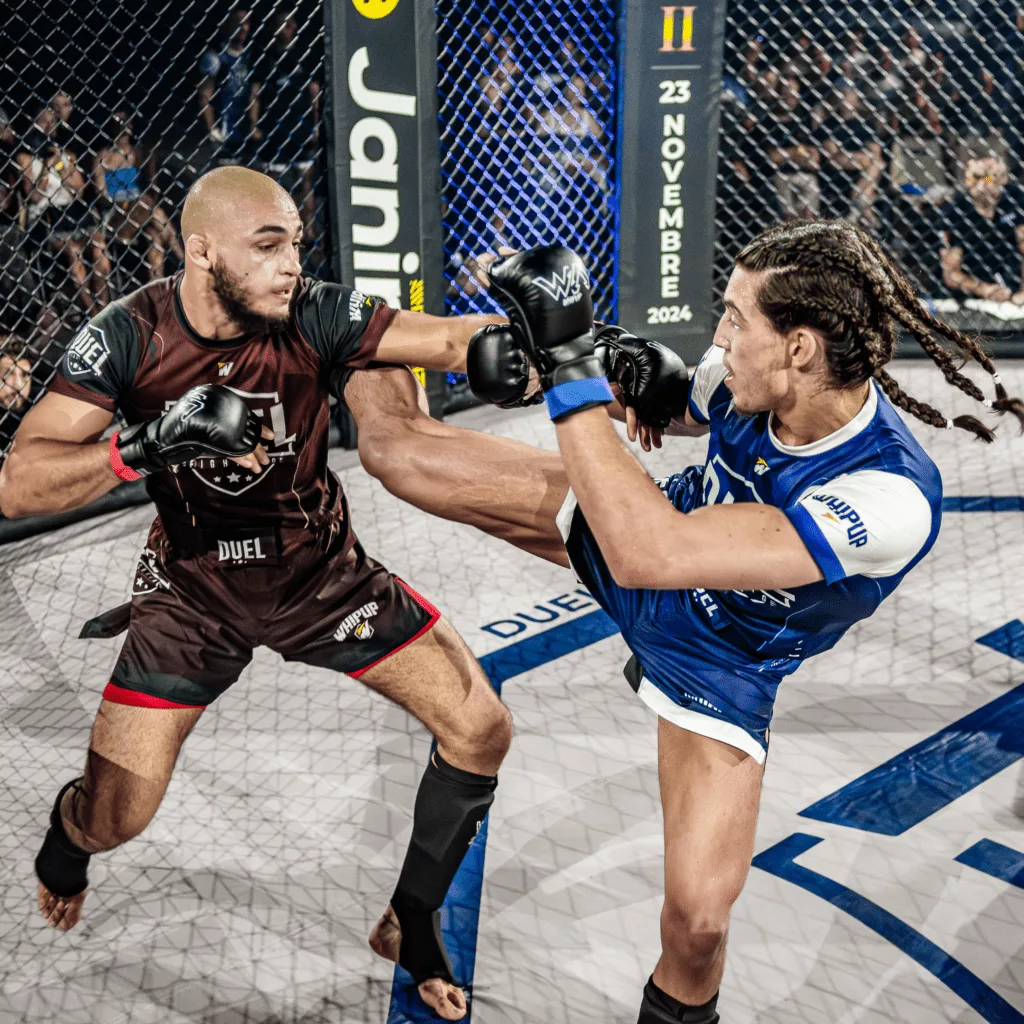
French promotion DUEL Fighting MMA has introduced a real-time “Monetary Timer” that places a visible cash bounty on every second of a bout—bigger rewards for faster finishes. Immediate bonuses typically range from €200 to €2,000, and the clock is designed to push action toward stoppages rather than decisions.
What happened
- Public debut: DUEL 4 (June 2025), marketed as the largest amateur MMA event staged in France. Four of the ten contests ended inside the time limit.
- Next use: DUEL 5 in Albertville on October 18, 2025.
- How it appears: A synchronized countdown and live prize pool visible in-arena and on broadcast/streams.
How it works (operationally)
DUEL positions the timer as a production “conductor” that aligns refereeing, TV direction, big screens, and livestream overlays. The effect: a single source of truth for the remaining time and the live bonus value—no discrepancy between what the fighter, crowd, and viewer see.
IP and expansion pathway
The concept is registered with INPI (France), APP (France/Europe), and the U.S. Copyright Office, signalling intent to license internationally. DUEL says the model could travel to boxing, kickboxing, and e-sports, and cites early interest from KSW in Poland.
Why it matters
1) Incentives made visible. Combat sports already pay win/finish bonuses, but these are usually backstage economics. DUEL puts the incentive inside the narrative arc of the fight, which can change pacing, strategy, and the energy in the building.
2) A new drama mechanic. The countdown reframes the final minute of a round: not only “can they finish?” but “how much is left in the pot?” That adds tension comparable to a power-play clock or a penalty shootout—only with money on screen.
3) Broadcast and arena UX. Because the timer is synchronized across all surfaces, directors can build replays, wipe graphics, and commentary beats around a single, dynamic object. This is a plug-and-play storytelling device, not just a payout rule.
4) Commercial creativity. A visible bounty invites sponsor formats (“Beat-the-Clock Bonus presented by ___”), dynamic ad triggers (“bonus doubles in the final 30 seconds”), and social extensions (“fan vote to add €100 to the pot”). It’s a modular asset more than a static brand slot.
5) Competitive identity. If adopted widely, this would differentiate promotions by tempo philosophy. Leagues that overweight stoppages can cultivate a distinct product signature—useful in a crowded global calendar.
Design questions that still matter
- Safety vs. spectacle: Will fighters take riskier lines to chase the clock? Governing bodies may want guardrails: medical oversight metrics, ref training, and coach guidance to keep incentives aligned with welfare.
- Competitive integrity: Does the bounty unduly shape judging optics if a finish chase fails and the fight goes to the scorecards?
- Fairness and parity: Are bonuses scaled appropriately across weight classes and genders? How are amateur versus pro tiers handled?
- Fan comprehension: Is the mechanic immediately legible to casual viewers? Simple on-screen copy and consistent commentary language will be key.
What smart adopters will measure
- Finish-rate delta: Change in inside-the-distance outcomes vs. historical baseline.
- Average time-to-finish: Are climaxes actually arriving earlier?
- In-arena response: Decibel peaks and engagement spikes at time thresholds (e.g., 60s, 30s).
- Digital lift: Clip-through rates for “countdown” moments, watch-time around timer peaks, and social mentions of the mechanic.
- Fighter sentiment: Post-bout surveys on pressure, strategy, and perceived safety.
- Sponsor ROI: Uplift in recall and conversion for timer-linked creative vs. standard inventory.
Licensing outlook
With registrations in place and a clear production blueprint, DUEL can license the timer as:
- A turnkey pack (graphics, logic, referee cues, training, and QA).
- A white-label module embedded in a promotion’s app or OTT, enabling fan “top-ups” or partner-funded boosts.
- A ruleset variant for specific cards (e.g., “Finish Clock” nights) that concentrate marketing without rewriting an entire season.
Founder’s stance (paraphrased)
DUEL founder Charles Navillod frames the timer as another step in the promotion’s innovation track: add tangible motivation for athletes while turning the final seconds of each round into premium drama for fans.
365247 POV
The Monetary Timer is less about money and more about making incentives legible. When the reward is visible, it becomes story, and story is what travels across platforms. If DUEL keeps the mechanic simple, fair, and safe—and pairs it with sharp sponsor formats—this could become a repeatable export. The most interesting test will be whether finish-rate and watch-time gains persist after the novelty window closes.
For Brands, Businesses and Services, feature in our ecosystem
IMAGE: Duel MMA