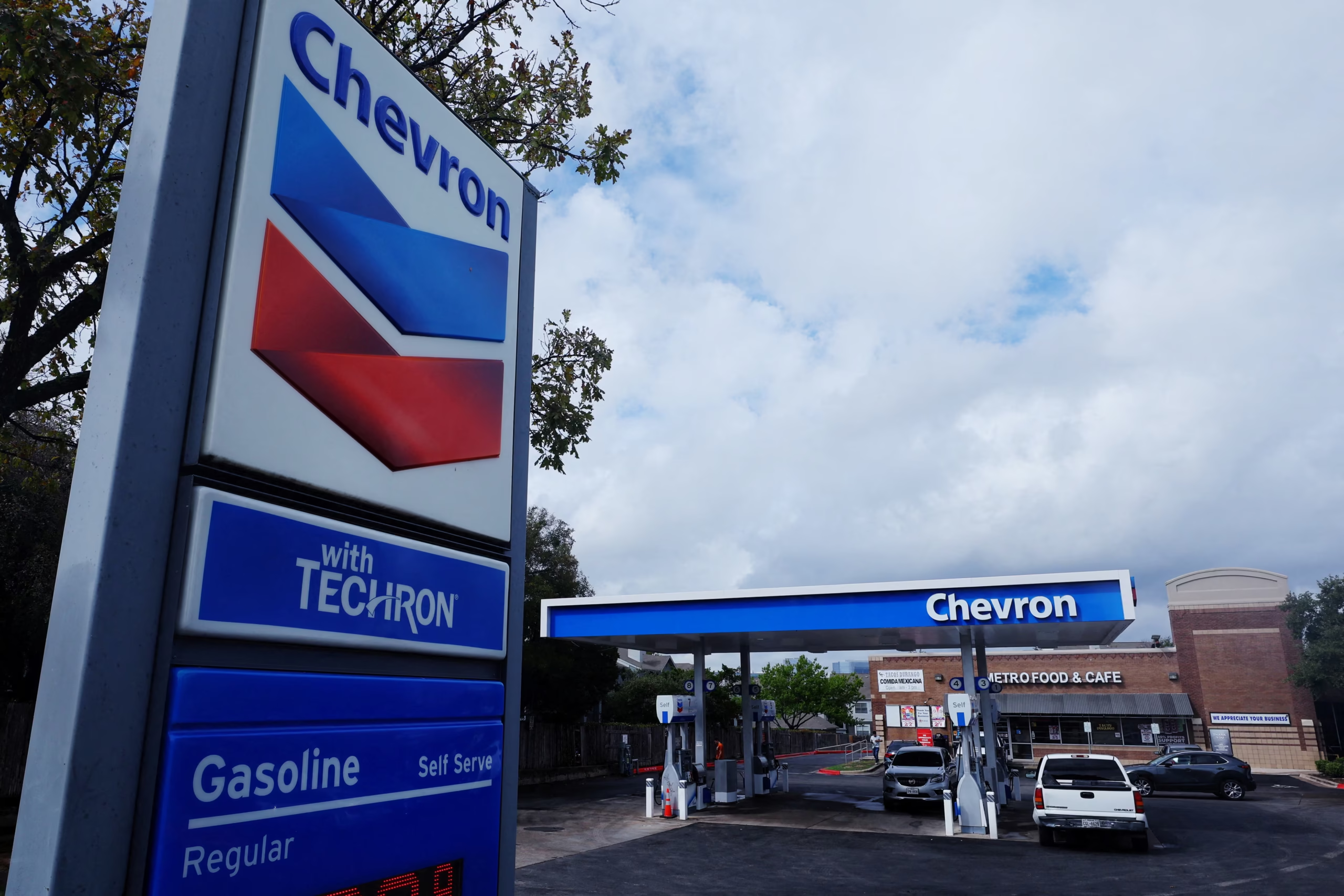
Chevron has officially completed its $55 billion acquisition of Hess Corporation—marking a significant consolidation in the energy sector—but not without a bruising battle. The merger, originally announced in October 2023, faced a year-long delay due to arbitration challenges initiated by ExxonMobil over Hess’s coveted stake in the Guyana oil frontier.
While the deal is now done, the road was far from smooth. The friction stemmed from Hess’s 30% interest in the Stabroek Block, one of the most prolific offshore oil discoveries in recent decades. Exxon, which operates the Guyana site and owns a 45% stake alongside Chinese partner CNOOC, argued that it had pre-emptive rights over any sale of Hess’s assets in the region. Arbitration ultimately did not rule in Exxon’s favor—but the delay itself proved strategically disruptive.
Billions Deferred, Not Denied
Though Exxon failed to halt the deal, it managed to keep Chevron from realizing substantial value for over 12 months. Analysts estimate the delay kept over 180,000 barrels per day—roughly $6–7 billion in gross revenue—outside Chevron’s portfolio during 2024. It also deferred around $3 billion in potential profits, slowing Chevron’s planned integration and forcing investors to navigate months of legal ambiguity.
For Chevron CEO Michael Wirth, the Hess deal was not just a growth initiative—it was a defensive counter to Exxon’s $60 billion acquisition of Pioneer Natural Resources, which closed earlier and cemented Exxon’s dominance in the Permian Basin. With Hess, Chevron gains critical access to Guyana’s rapidly scaling production and long-term international reserves.
Strategic Overhang Now Lifted
With the transaction now finalized, Chevron aims to generate $1 billion in annual cost synergies by end-2025. This includes job cuts due to overlapping roles across the two entities. The company has also committed to broader efficiency measures amid wider restructuring, including a workforce reduction of up to 20% globally.
Chevron’s shares have underperformed relative to Exxon’s since the two megadeals were unveiled in late 2023. Much of that underperformance can be traced to the uncertainty surrounding the arbitration. In the same period, Exxon shares climbed slightly, while Chevron’s dipped nearly 9%. That divergence narrowed slightly once the deal closed, but the sentiment damage was done.
The arbitration also came at a financial cost. Legal fees, advisory expenses, and integration preparations—including a $2.2 billion stake in Hess and $5.5 billion in new debt issuance—added pressure to Chevron’s short-term financials.
Wider Implications for Big Oil
This episode underscores the high-stakes nature of consolidation in the oil sector. While both Exxon and Chevron are pursuing aggressive M&A strategies to secure long-term assets, the Hess ordeal shows that control over emerging energy geographies like Guyana can trigger geopolitical, legal, and financial complications.
For Chevron, the finish line has finally arrived—but at a steep toll in both time and trust. And in today’s rapidly shifting global energy market, time is often the more expensive currency.
IMAGE: Reuters