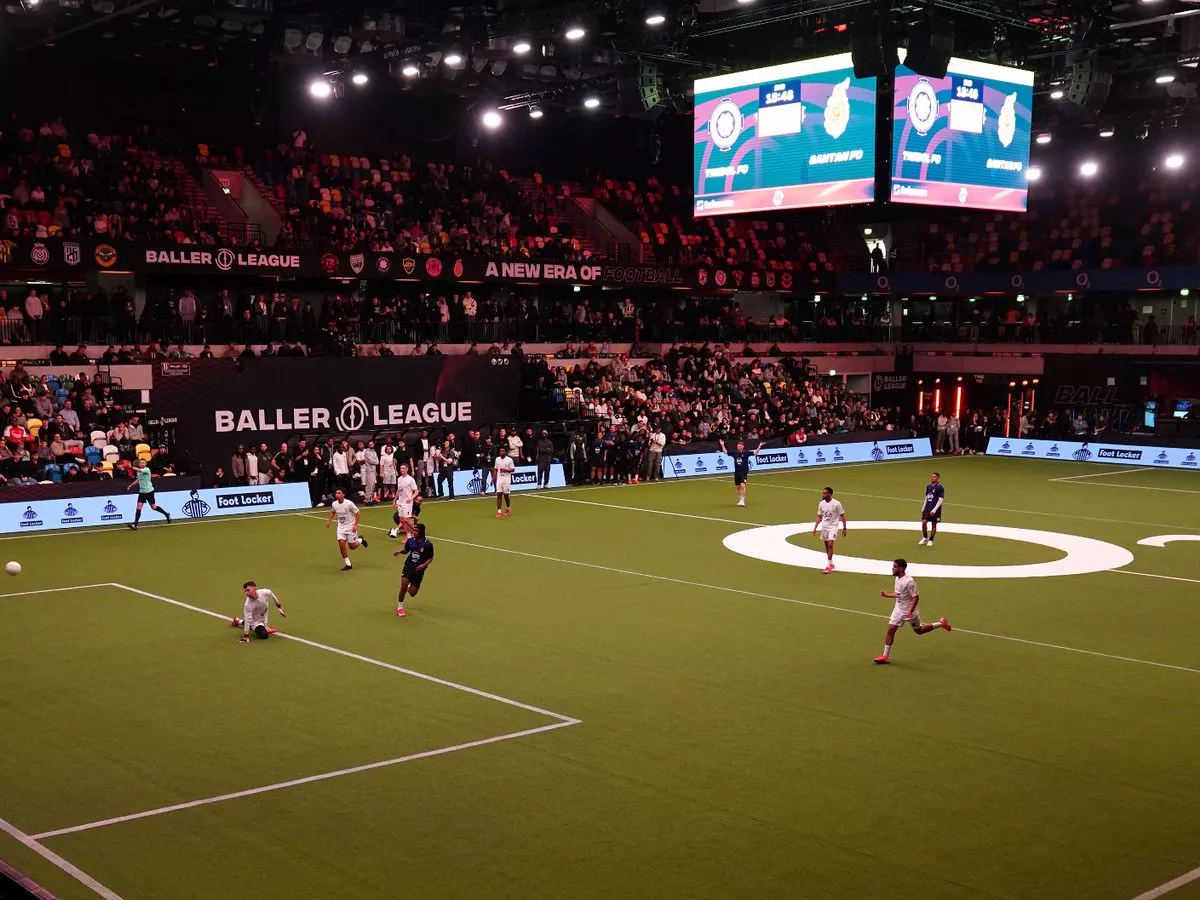
The Baller League is not just a new soccer competition—it’s a go-to-market case study for how to win Gen Z and Millennial attention in 2025 and beyond. The trailer that’s been buzzing across creator channels sets the tone: short, sharp, meme-ready sport wrapped in creator culture, built to travel across platforms—not just sit in a weekend TV slot.
Here’s what matters and why.
What the Baller League is really selling
A creator-led sports product. The UK launch was built around influencers and ex-pros managing six-a-side teams, with YouTubers and streamers heavily integrated into the cast, and broadcast distribution running across both traditional and digital partners. That’s not accidental—it’s the model. The league blends broadcast reach with creator distribution so the audience doesn’t have to come to the rights-holder; the product goes to the audience.
A ruleset tuned for short attention. Think faster matches, fewer stoppages, “gamechanger” mechanics and made-for-clip moments. The result: more highlight density per minute, more hooks for social, and less dead time to doom-scroll away. (Multiple UK reports detail 15-minute halves, visible offside lines, no corners, “double-goal” windows, and penalty-style shootouts—rules engineered for pace and shareability.)
A global expansion thesis. Baller League isn’t hiding its ambitions. Management has openly discussed taking the format from Europe to the US and beyond, leaning on creators to seed demand in new markets and seeking hybrid broadcast/streaming partners to scale. That’s a playbook we’ve seen succeed with other creator-sports properties.
Why this approach is built for the new fan
- Gen Z doesn’t discover sports on TV first. They find it in Shorts, TikTok, Twitch and YouTube—then graduate to longer formats. Deloitte’s recent outlook notes short-form video and creator-driven content as a primary on-ramp for younger fans, with leagues retooling production accordingly.
- Co-streaming broadens reach and lowers median age. Look at the NFL’s Thursday Night Football on Prime Video: younger median age than linear TV and strong gains when measured on streaming-first currency—proof that digital distribution plus watch-party culture unlocks cohorts broadcast alone doesn’t reach.
- There’s precedent—and numbers. Spain’s Kings League (the closest analogue) turned creator presidents, game-show rules and social-first production into real business: €20.5m revenue in its first full year and a 92,000-fan Final Four at Camp Nou. Baller League is writing from that same template, localized and refreshed.
The Baller League marketing stack (what’s working)
- Creators as distribution, not just promotion
Managers and guests with multi-million followings bring built-in reach. Their content teams manufacture daily storylines and micro-beats (training skits, locker-room snippets, IRL meetups), pushing the league into feeds where traditional trailers rarely land. - Platform pluralism by design
Linear partners deliver legitimacy and households; Twitch/YouTube creators deliver youth reach, interactivity and time-spent. Baller League is engineered for both simultaneously, turning every match into dozens of creator POVs and thousands of fan-made clips. - Clip-rich rules = algorithm fuel
Shorter halves, power-play moments and penalty shootouts compress excitement and reduce “scroll away” moments. Every minute is a potential vertical video. That’s not a quirk—it’s a growth system. - Eventization over fixtures
Drops, surprise cameos, celebrity captains, city-takeovers—format the calendar like a sneaker launch, not a league schedule. The UK Copper Box debut followed this path; the US trailer doubles down on spectacle. - Brand inventory built for creators
From jersey collabs to shoulder content and live-read integrations inside co-streams, the property creates sellable moments native to social video, not just signage locked inside a 90-minute broadcast.
What every league can learn (and adapt)
- Build for clips first, then for TV. If the in-game product doesn’t produce shareable sequences every 90–120 seconds, your social team is trying to make bricks without clay.
- License co-streams—intelligently. Controlled creator co-streams (pre-approved overlays, brand safety, clear ad lanes) can add millions of incremental impressions and lower your average viewer age overnight.
- Ship storylines daily. Treat every match week like a reality series: rivalries, drafts, selection rooms, mic’d-up snippets, vote-ins. Publish across Shorts, TikTok, Reels—then bundle the best into your broadcast shoulder.
- Make scouting and stats fan-facing. Turn data and selections into content (live drafts, pick explanations, on-screen x-factor meters). Fans don’t just want outcomes; they want the process.
- Price for participation. Consider low-friction membership passes (discounted drops, early venue access, digital keepsakes) to convert casual scrollers into paying community members.
365247 Consulting: your next-gen go-to-market
We help rights-holders and teams turn “attention spikes” into repeatable revenue. The short version of our playbook:
- Format tuning: We stress-test your rules and timing for clip density and session length.
- Creator network design: We map the right creators per market, negotiate co-stream lanes, and set brand-safe guardrails.
- Content OS: We install a newsroom that ships 30–50 micro-assets per match window, with clear hand-offs from players to editors to partners.
- Monetization architecture: We align sponsor inventory to creator outputs (native reads, branded challenges, live polls) and build subscription-ready fan journeys.
There’s one lever we haven’t mentioned—the one that typically doubles week-two retention without spending extra on paid media. That’s the conversation we reserve for founders and CMOs who are ready to build for this audience properly.
Let’s talk. If you’re planning a creator-led league, re-launching a property, or trying to de-age your fanbase, 365247 can design and deploy the model—fast.
For Brands, Businesses and Services, feature in our posts
IMAGE: PA