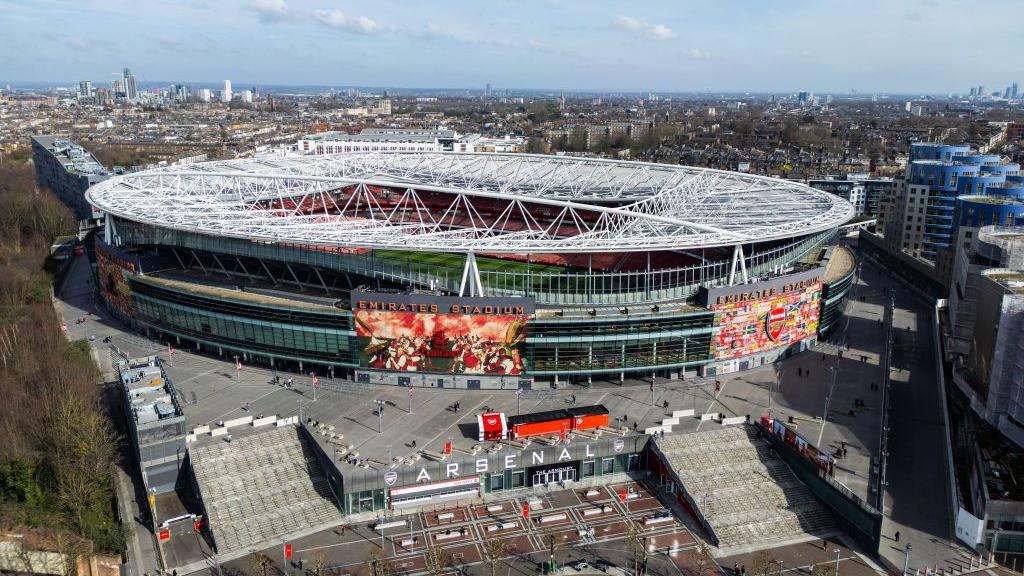
Arsenal Football Club is exploring an ambitious £500 million redevelopment of the Emirates Stadium — a project that could expand capacity to over 70,000 seats and reshape one of the Premier League’s most iconic venues. The plans, described by experts as a “complex logistical challenge,” reflect the club’s growing demand and long-term vision for matchday and commercial growth.
Expanding Arsenal’s Home: From 60,700 to 70,000+
According to The Telegraph, the project under consideration would involve re-tiered seating, steeper stands, and internal reconfigurations, adding around 10,000 new seats to the existing 60,700-capacity Emirates. While the stadium’s outer shell will remain largely unchanged, the internal redesign could be so extensive that Arsenal may need to temporarily relocate to Wembley Stadium, mirroring Tottenham Hotspur’s move during their stadium rebuild.
The expansion aims to address Arsenal’s season ticket waiting list of over 100,000 fans and strengthen matchday revenues — a critical pillar in the club’s self-sustaining financial model.
Engineering and Logistical Complexities
A working group is currently in discussions with leading architectural firms, though no formal planning application has yet been submitted. Experts suggest the planning process alone could take up to five years, due to the Emirates’ tight 17-acre site in a densely populated residential area.
Josh Risso-Gill, partner at Charles Russell Speechlys, described the redevelopment as a “complex logistical challenge,” citing significant spatial and infrastructure constraints:
“The site is hemmed in on three sides by residential areas and bordered by both the Piccadilly and Northern Underground lines. Transport, crowd management, and security will be central issues for any capacity increase.”
Risso-Gill also noted that Arsenal may need to revisit existing event restrictions — currently allowing only three non-football events per year — if the club plans to increase the use of the stadium for concerts or other commercial activations.
Heritage, Design, and the Next Chapter
Arsenal’s former home, Highbury Stadium, remains one of English football’s architectural landmarks, famous for its Art Deco design before being converted into Highbury Square, a listed residential complex.
When the £390 million Emirates Stadium opened in 2006, it represented one of the most advanced football infrastructures in Europe. The venue was designed by HOK Sport (now Populous), engineered by Buro Happold, and constructed by Sir Robert McAlpine, with key steelwork from Watson Steel Structures (now part of Severfield).
Nearly two decades later, this proposed expansion marks the first major structural change since the stadium’s opening — signaling Arsenal’s intent to evolve both on and off the pitch as global demand for live football continues to rise.
Don’t Just Watch Sport, Understand It. Join the 365247 Newsletter for daily insights