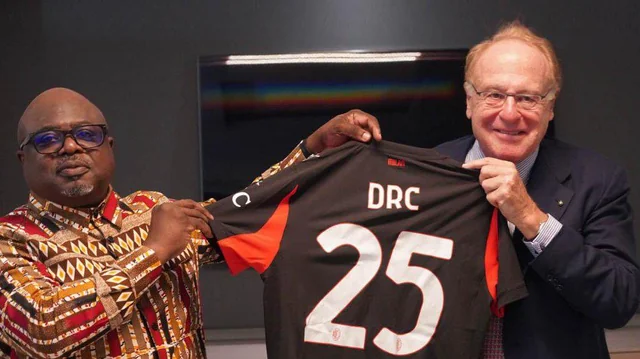
In an era where soft power is increasingly exercised through sport, the Democratic Republic of Congo has taken a bold strategic leap—signing a €14 million-a-year partnership with Italian football giants AC Milan.
The three-year deal, signed on June 19, 2025, in Rome, marks a significant attempt by the DRC to reposition itself on the global stage—not just as a resource-rich African nation but as a rising cultural, economic, and tourism player with football as the flagship.
A Partnership Beyond the Pitch
According to Congolese Tourism Minister Didier M’pambia, this agreement goes far beyond shirt sponsorships or logo visibility. It includes:
- International tourism campaigns powered by AC Milan’s global audience
- Infrastructure development, including the renovation of a sports facility and the construction of a school in Boma, in partnership with the Mama Sofia Foundation
- The launch of the first AC Milan Academy in DRC to train youth football talent
- Investment promotion for Congolese industries via Italy’s Lombardy region
- Cultural diplomacy, branding the DRC as a nation of creativity, energy, and ambition
Paolo Scaroni, chairman of both AC Milan and its charitable arm Fondazione Milan, emphasized the “innovative cooperation” in line with Italy’s broader Mattei Plan for Africa—a vision of deeper socioeconomic partnerships between Europe and the continent.
A delegation from AC Milan will soon visit Kinshasa to officially kick off the initiatives.
Sports Diplomacy: A Growing Trend in Africa
This move places the DRC alongside Rwanda, which has already executed global campaigns with Arsenal, PSG, and Bayern Munich through its now-famous “Visit Rwanda” initiative—arguably one of Africa’s most aggressive and successful sport marketing experiments.
Rwanda’s deals, although commercially questioned by critics, have led to a tangible increase in tourism and awareness. DRC appears to be following a similar blueprint—but with more layered objectives, including youth development, sport ecosystem revitalization, and global investor attraction.
There’s also ambition beyond Italy. DRC’s Sports Minister Didier Budimbu has signed a separate deal in principle with AS Monaco, including a proposed €4.8 million shirt sponsorship package.
The Tension Between Vision and Reality
However, not all feedback has been positive.
Locally, the Congolese football system is in disrepair. The national league has faced repeated suspensions and truncated seasons due to financial instability. Critics argue that before investing €14 million in European partnerships, the DRC must first rebuild its domestic sporting infrastructure.
Even geopolitical undertones have emerged. In February, the DRC publicly criticized Arsenal’s deal with Rwanda, referencing political tensions and conflict in the eastern region.
But Budimbu insists the partnership is about building a long-term, self-sustaining sports economy: “This is about creating socio-economic opportunities, not just sponsorship visibility. The DRC’s future will be built with talent, structure and action.”
Strategic Consultancy Perspective by 365247
At 365247, we see this as a bold nation-branding play rooted in the belief that sport can unlock untapped influence, investment, and innovation.
However, for countries or clubs considering a similar move, several factors must be aligned:
What Works in These Mega Partnerships:
- Strategic alignment between nation brand and club identity
- Commercial pathways beyond visibility—tourism, education, digital platforms, and grassroots academies
- Local community engagement to ensure buy-in from citizens and fans
- Measurable KPIs for tourism, FDI (foreign direct investment), and youth sports output
What Must Be Avoided:
- Over-indexing on visibility without performance or local league development
- Ignoring geopolitical optics in cross-border partnerships
- Sponsoring foreign clubs while domestic leagues collapse
- Treating sport as a PR gimmick instead of a long-term industrial opportunity
Want to Build a Nation-Club Sports Partnership That Works?
At 365247 Consultancy, we design purpose-built partnerships that drive national visibility, economic opportunity, and long-term sport ecosystem development.