For sports properties and executives looking to future-proof sponsorship, athlete IP is no longer a patch on the jersey—it’s a product, a platform, and a programmable asset. The Adidas–Patrick Mahomes partnership shows how to do it right.
1) From endorsement to IP platform
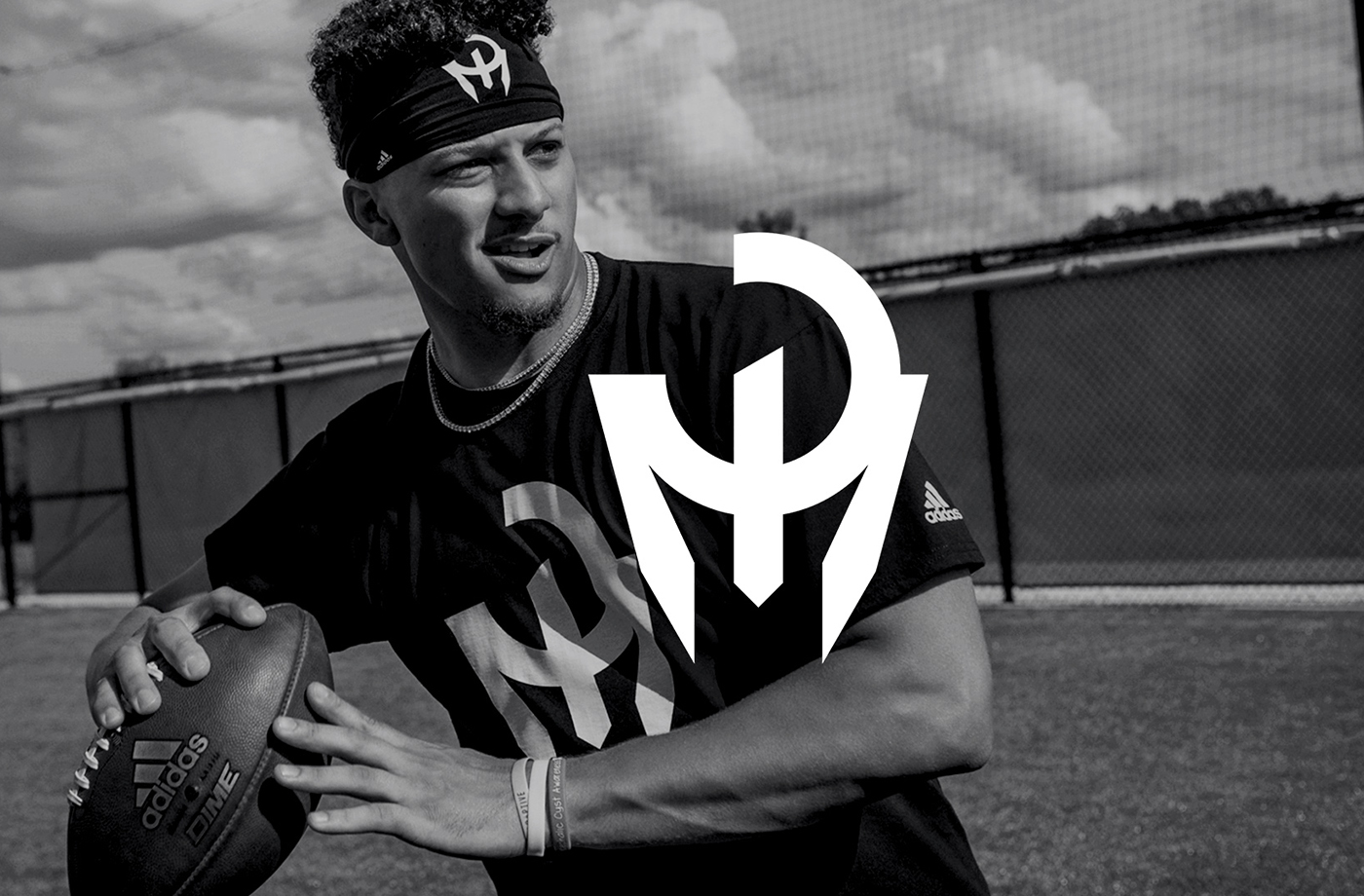
Adidas didn’t just sign Patrick Mahomes to a footwear deal; it helped stand up a distinct, ownable brand identityanchored by his personal mark—the “Gladiator” logo—with supporting marks like “Always 2PM.” Mahomes publicly framed the logo’s intent (mindset, impact, daily discipline), creating narrative equity that travels across product, content, and environments.
What started as a logo now powers a full line (training footwear/apparel), with the mark placed prominently on tongues, tees, and merchandising, creating consistent shelf recognition and a repeatable visual system.
Executive takeaway: If you want longevity, co-create IP with your star—don’t just rent their likeness. Codify story, secondary marks, lockups, and usage rules early.
2) Product cadence that compounds attention
Adidas moved from the Mahomes 1 Impact FLX to follow-on colorways (“Away”) and then Mahomes 2, layering seasonal narratives (road identity, race-against-time motifs) to sustain demand and PR moments. This cadence keeps the logo in market continuously without creative fatigue.
On its commerce surfaces, Adidas aggregates the Mahomes ecosystem—footwear, apparel, and capsules—so the logo acts as a shop-by-athlete door, not just a product embellishment.
Executive takeaway: Treat athlete drops like a mini portfolio. Rotate storylines and price ladders (from $30 tees to $150 trainers) so each new chapter refreshes the IP without resetting it.
3) Extending the mark into teams, venues, and communities
The Mahomes brand moved from retail to the field: Adidas and Mahomes placed the Gladiator logo into official Texas Tech football uniforms—an uncommon step that elevated a personal mark into sanctioned on-field identity. The initiative coincided with a 10-year Texas Tech × Adidas deal, demonstrating how athlete IP can amplify institutional partnerships.
Beyond the college game, the Team Mahomes NIL cohort and high-school integrations bring the logo into development pathways, seeding future fandom and creating a flywheel of content, performance, and community service under a single visual banner.
Executive takeaway: Athlete logos can be multi-tenant assets—appearing on uniforms, NIL programs, and grassroots activations—if governance and rights are negotiated up front across property tiers (HS/college/pro).
4) Why the Mahomes logo travels
- Narrative clarity. The Gladiator mask stands for competitive mindset; “2PM” ties to name and timing under pressure. These are simple, memorable ideas fans can repeat.
- Design versatility. The mark performs at micro (tongue badge) and macro (uniform crest, broadcast camera pick-ups) scales.
- Ecosystem breadth. From signature footwear to on-field uniforms and NIL, the logo appears where fandom happens, not just where ads run.
Executive takeaway: Before you draw a logo, write the creative brief that defines (a) the athlete’s enduring idea, (b) the surfaces it must live on, (c) the communities it will serve.
5) What this means for properties and rights-holders
a) Co-branding architecture.
Build explicit guidelines for tri-party marks (league/club × brand × athlete). Decide when the athlete logo can be primary (special uniforms), secondary (training kits), or tertiary (retail swing tags). Texas Tech’s execution shows how to do this with governance and ceremony.
b) Inventory innovation.
Create logo-eligible media: tunnel shots, warm-ups, practice days, NIL days, and digital overlays where athlete marks are permissible without breaching league uniform rules.
c) IP and compliance.
Map trademark ownership, sublicensing, and moral-rights clauses early. Specify what happens with retired colorways, charity editions, or cross-category expansions (e.g., esports, lifestyle). (Adidas’ long-running athlete signature programs make this operationally feasible.)
d) Measurement.
Track the logo, not just the jersey sponsor. Use CV/AI to measure logo screen time and recognition on footwear, apparel, and uniforms; attribute traffic to athlete-branded PDPs; and segment NIL participants exposed to the mark vs. control groups.
6) Commercial upside: the virtuous loop
- Signature product launches introduce the mark at scale.
- On-field appearances legitimize it in competition.
- NIL & grassroots create ubiquity and social proof.
- Retail & content convert attention back into sales and first-party data.
Adidas’ rollout—from Mahomes 1 to Mahomes 2, from road “Away” stories to city activations—shows that if you keep the storytelling moving, the logo compounds brand equity over time.
7) Practical playbook for executives
- Codify the system. Primary mark, secondary icons, typography, color rules, motion rules. (Mahomes’ Gladiator + 2PM is your blueprint.)
- Pre-clear surfaces. Where can the athlete mark appear across your property (warm-ups, training gear, NIL uniforms, fan retail, venue signage)? Texas Tech’s pathway demonstrates a clear model.
- Bundle the drops. Pair product with community (NIL/HS) and venue moments to create a whole-week narrative, not a single SKU release.
- Measure the mark. Treat the athlete logo as a KPI: logo impressions, aided/unaided recall, click-through to athlete PDPs, conversion, and repeat rates on athlete-branded lines.
8) The big picture
The Adidas × Mahomes program shows how a personal logo can evolve into a scalable business system—a mark that sells shoes, energizes uniforms, powers NIL, and unites communities under a single, repeatable idea.
For properties, the question isn’t whether to allow athlete IP on your platform—it’s how to structure it so everyone wins: the club (authentic storytelling), the brand (distinctive equity), the athlete (ownership and longevity), and the fan (clear meaning and value).
If you get those pieces right, a logo isn’t decoration. It’s distribution.