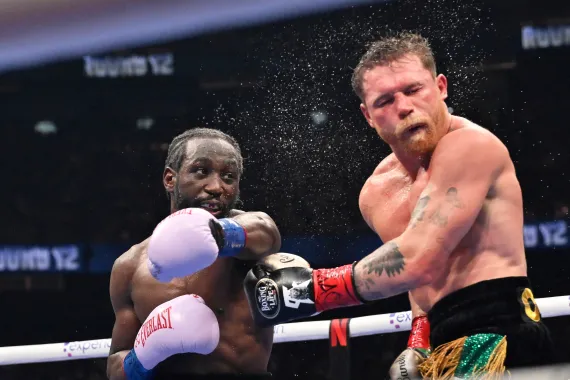
Las Vegas witnessed history on Saturday night as Terence Crawford outpointed Canelo Álvarez by unanimous decision to become the undisputed super-middleweight champion of the world.
At Allegiant Stadium, home of the NFL’s Raiders, a record-breaking 70,482 fans packed the $2bn venue — the largest boxing crowd ever in Las Vegas. While the vast majority roared in support of Álvarez on Mexican Independence Day weekend, it was Crawford who silenced them, moving up two weight classes at age 37 to hand the Mexican superstar only the third defeat of his storied career.
The judges scored the fight 116-112, 115-113, 115-113, all in favor of Crawford, who now extends his perfect record to 42-0 with 31 knockouts.
A Landmark Victory
Crawford’s win is more than just another belt. It redefines his place in boxing history: a fighter from Omaha who survived a gunshot wound as a young man, now becoming the first man to defeat Canelo on Mexican Independence weekend — a date traditionally dominated by Mexican champions.
For Canelo, the loss dents his aura of invincibility. For Crawford, it confirms his status as one of the greatest pound-for-pound fighters of the modern era.
The Business of Boxing: A New Era
While the fight was historic inside the ring, it was also groundbreaking outside it.
- Streaming on Netflix: Millions watched worldwide at no extra cost to subscribers, a radical shift from boxing’s long dependence on the pay-per-view model. Instead of maximizing revenue per fight, the strategy was about scale, global reach, and accessibility. If successful, this could disrupt how elite boxing events are broadcast going forward.
- Venue Impact: Allegiant Stadium more than doubled the previous Las Vegas boxing attendance record set in 1982 (29,214 for Larry Holmes vs. Gerry Cooney). It showcased how stadium fights are now as much about spectacle as sport, rivaling mega-events like Super Bowls and World Cups.
- Zuffa Boxing Debut: This was also the launch event for Dana White’s Zuffa Boxing under TKO Holdings, with financial muscle from Saudi sports magnate Turki al-Sheikh. Backed by Saudi investment, boxing is increasingly becoming part of the Kingdom’s wider sports strategy — mirroring its approach in football and combat sports.
Politics, Regulation & The Future
The timing of the fight intersected with political debates in Washington, where a proposed Muhammad Ali American Boxing Revival Act aims to reshape the sport’s regulatory framework. Questions around fighter welfare, promotional dominance, and financial transparency remain hotly debated — and nights like these only intensify scrutiny.
Legacy and Symbolism
Crawford’s victory carried deep symbolism. Against all odds, in a venue designed to celebrate Canelo, he delivered a masterclass in composure, ring IQ, and technical brilliance.
On a night meant for Mexican pride, it was the American outsider who walked away with boxing immortality.
Crawford is no longer just a champion — he is a standard-bearer for boxing’s new era, where fighters, broadcasters, and investors are reshaping what the sport looks like on a global scale.
365247 Insight:
This fight wasn’t only about belts — it was about narratives, business models, and global positioning. Netflix’s entry, Saudi investment, and stadium-scale boxing underline where the sport is heading: a hybrid of combat and entertainment built for worldwide audiences.
For Brands, Businesses and Services, feature in our posts
IMAGE: AP