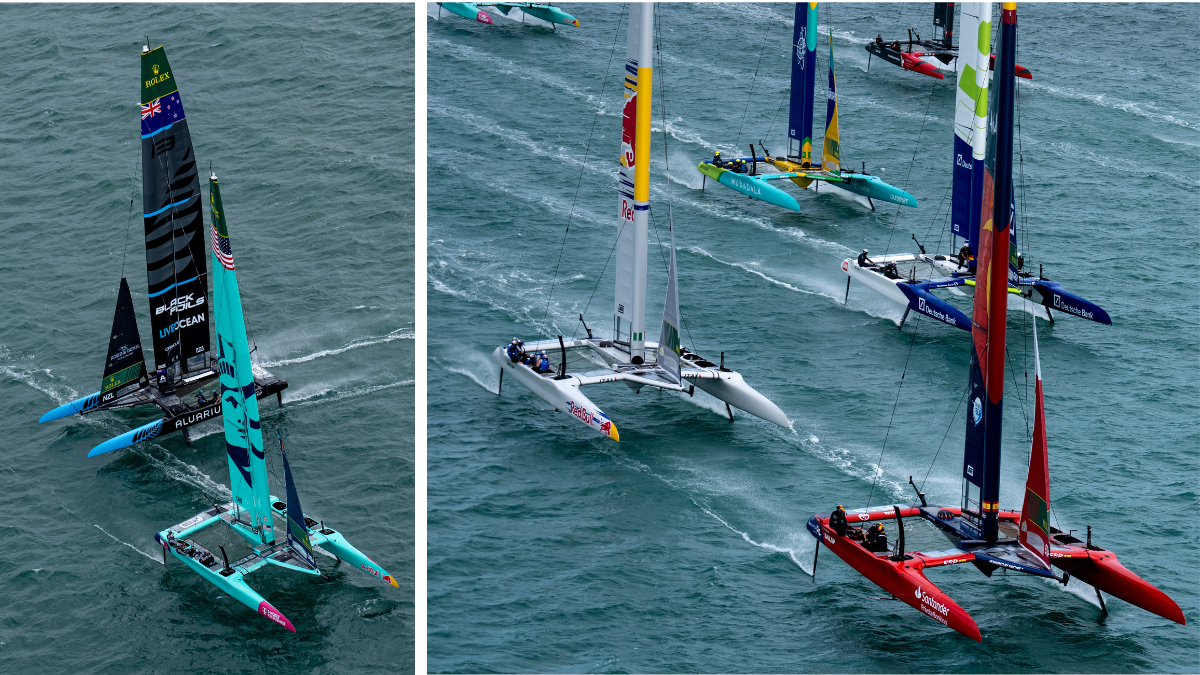
Credit: Insider Sport
SailGP isn’t just another sailing competition. It is a purpose-built global sports property, designed to merge high-performance racing with a modern, commercially scalable model. From hydrofoiling catamarans that appear to “fly” above the water to its expanding footprint across key growth markets, SailGP is positioning itself alongside Formula 1, UFC, and America’s Cup as one of the world’s premier motorsport and entertainment properties.
The Spectacle of the F50
At the heart of SailGP lies the F50 catamaran—a boat that doesn’t merely sail but flies. With six crew members working in sync, the hydrofoils lift the craft above the surface, hitting speeds of up to 100 km/h. Races unfold in city harbors and waterfronts—New York, Sydney, Dubai—creating the perfect theater for live spectators and television.
This is sport engineered for the modern attention span: short, adrenaline-packed races where a single misjudged gust of wind can end a campaign. For broadcasters and fans, it’s as much spectacle as competition.
Expansion and the Quest for Scale
Managing Director Andrew Thompson has been clear: SailGP’s ambition is to compete with the top 20 global sports properties. That means scaling its calendar to 18–20 events per season (from its current ~12) and planting flags in key markets like China, Japan, Mexico, the UAE, and Saudi Arabia.
This expansion strategy mirrors F1’s global footprint playbook but is accelerated by central ownership and now, the transition to a franchise model.
The Franchise Model: Scarcity as Value
Initially centrally owned for speed and agility, SailGP is now rolling into a private ownership model. The league has capped licenses at 20, with 12 already placed. Scarcity is driving value, and since Endeavor bought into the property in 2020, SailGP’s valuation has grown fivefold.
Celebrity and institutional capital are flowing in:
- Australia: “BONDS Flying Roos,” co-owned by Hugh Jackman and Ryan Reynolds.
- Germany: Sebastian Vettel (ex-F1 champion) and Thomas Riedel.
- Italy: Anne Hathaway as part of the first female-led ownership group.
- France: Kylian Mbappé’s Coalition Capital and Ares Management.
- USA: Marc Lasry’s Avenue Sports Fund, joined by Deontay Wilder and Issa Rae.
This isn’t just money—it’s reach. Stars bring marketing ecosystems that broaden SailGP’s global awareness.
Media Strategy: Beyond Broadcast
Thompson’s philosophy is clear: the league doesn’t just want broadcasters to buy rights, it wants partners who invest in growing the property. That’s why Germany’s ZDF broadcast drew 2+ million viewers, and why SailGP also leans heavily on YouTube and TikTok.
The league’s average broadcast audience now hits ~20 million live or near-live viewers per event, while its short-form content is building youth engagement. Crucially, SailGP owns its telemetry data, hosted in Oracle Cloud, which feeds real-time graphics and AI-enhanced insights.
This data is also the foundation for SailGP’s entry into sports betting, partnering with DraftKings and bet365 to offer in-race markets. For a league still in its growth curve, this is a bold additional revenue stream.
Profitability and Cost Control
Unlike other motorsports, SailGP enforces a team cost cap of $10 million annually. The model ensures investor confidence and sustainable growth. Several teams—France, Great Britain, Brazil—are already at or near breakeven, proving the system works.
The guiding principle: “Strong league, strong teams.”
Sustainability and Inclusion: A Differentiator
SailGP isn’t just selling speed—it’s selling values. Its Impact League is the world’s first parallel sustainability championship, rewarding teams for cutting emissions, reducing waste, and promoting gender equity.
Highlights include:
- GB SailGP Team generating 5,600+ kWh of renewable energy at events.
- A triple-gold UN Climate Neutral Now recognition—the first sport to achieve it.
- A Women’s Pathway program, ensuring female athletes have raced in every event since 2021.
Brazil’s Martine Grael became the first female driver, winning races in her debut season. This inclusivity is embedded, not superficial.
Commercial Challenges Ahead
For all its momentum, SailGP still faces commercial hurdles:
- Media monetization gap: impressive reach, but rights fees lag behind F1 and UFC.
- Host-city economics: high logistical costs and weather risks make profitability fragile without bid-fee standardization.
- Star-building: parity ensures competition, but the league needs recognizable heroes and rivalries to grow mainstream appeal.
- Sponsor education: sustainability is a hook, but converting ESG interest into premium spend takes sophisticated packaging.
The Path Forward
To cement itself as a tier-one motorsport, SailGP should:
- Guarantee home fixtures for franchises, unlocking local sponsorship and hospitality annuities.
- Bundle broadcast + digital rights into hybrid packages (linear + free YouTube), balancing reach and ARPU.
- Productize data as a standalone rights stream for betting, fantasy, and media overlays.
- Build a creator ecosystem that turns sailors into mainstream influencers, similar to F1’s “Drive to Survive” effect.
- Codify sustainability deliverables into sponsor ROI metrics, enabling access to ESG budgets.
SailGP has the ingredients to be the world’s next big motorsport: a thrilling product, scarcity-driven franchise value, global expansion ambitions, and a unique sustainability-first brand identity. The challenge now is commercial choreography—turning awareness and innovation into predictable, premium revenue streams.
If SailGP succeeds, it won’t just redefine sailing—it could redefine how sports properties are built in the 21st century.
For Brands, Businesses and Services, feature in our posts
IMAGE: SailGP