Credit: Sports Business Journal
When Jeffrey Lurie bought the Philadelphia Eagles in 1994 for $185 million, few imagined the franchise would become one of the NFL’s most consistently competitive organizations. Three decades later, with two Super Bowl championships, cutting-edge infrastructure, and a reputation for sound leadership, the Eagles stand as a benchmark for modern franchise building.
Lurie has achieved this not through bluster or empire-building, but by blending humility, academic rigor, and a willingness to take risks others avoid. In an NFL dominated by outspoken personalities like Jerry Jones and Robert Kraft, Lurie’s style is quieter — but no less effective.
A Leadership Voice That Matters
At 74, Lurie enters the 2025 NFL season as one of the league’s most respected owners. He’s not the chairman of powerful committees nor the headline-maker in media rights negotiations. Instead, he has built influence through measured interventions — such as his high-profile defense of the Eagles’ now-famous “Tush Push” play, which he successfully kept legal despite league pressure to ban it.
“He doesn’t speak often, but when he does, people listen,” Miami Dolphins CEO Tom Garfinkel noted. That selective, well-prepared voice has made Lurie a “glue guy” in NFL politics: trusted, thoughtful, and often the one who reframes debates from the perspective of the fans.
Building a Winning Organization
Lurie’s tenure hasn’t been without early challenges. The Eagles of the 1990s struggled, their facilities outdated and culture unsettled. But in 1999, he made the unconventional choice to hire Andy Reid, then a little-known quarterbacks coach. That decision not only propelled the Eagles to a Super Bowl by 2005 but also set the template for how Lurie operates: making counterintuitive calls that prove visionary in hindsight.
Since then, Philadelphia has won 11 NFC East titles, four NFC Championships, and two Super Bowls — all while cycling through five head coaches and seven starting quarterbacks. The consistency, as Rams President Kevin Demoff observed, “points back to ownership rather than the individuals.”
Culture, Humility, and Process
Central to Lurie’s philosophy is culture. He emphasizes risk-taking, critical analysis, and humility. Mistakes are acknowledged quickly and corrected — never left to fester. This mindset shaped one of the most pivotal decisions in Eagles history: drafting Jalen Hurts in 2020. Despite Carson Wentz being entrenched as franchise quarterback, Lurie encouraged GM Howie Roseman to stick to his values. That bold call has since redefined the team’s trajectory.
It also explains how Lurie managed delicate leadership transitions, such as demoting and later reinstating Roseman, turning a potential fracture into a long-term competitive advantage.
Beyond Football: Purpose and Philanthropy
While Lurie’s primary focus remains the gridiron, his impact extends well beyond it. In 2019, he established the Eagles Autism Foundation, which has raised over $40 million. In June 2025, he committed $50 million to create the Lurie Autism Institute — a landmark partnership between Penn Medicine and Children’s Hospital of Philadelphia.
This dual commitment — to excellence on the field and meaningful change off it — mirrors the approach of sporting icons Lurie admires, such as Celtics legend Red Auerbach, who combined winning with breaking racial barriers in sports.
The Businessman’s Edge
Financially, Lurie has shown foresight. He supported relaxed NFL debt limits, championed the removal of restrictive cross-ownership rules, and was an early advocate for private equity investment in teams. Those reforms, once controversial, are now central to the league’s growth strategy.
He has sold minority stakes in the Eagles at valuations exceeding $8 billion but remains committed to long-term ownership. “I’m very bullish on the next decade,” he says, pointing to surging media rights demand as proof that the NFL’s growth curve is far from finished.
Guarding Against Complacency
For Lurie, the greatest danger is not external competition but internal complacency. “My biggest concern is any sign of self-entitlement,” he explains. “What gives us a chance to be very good, consistently, is humility and gratitude.”
That humility is evident even in moments of triumph. Despite his wealth and accolades — from Super Bowl rings to Academy Awards for his documentary production company — Lurie frames his role as custodian, not conqueror.
A Model for Modern Ownership
Jeffrey Lurie’s Eagles are more than a football team. They are a case study in how thoughtful ownership, grounded in humility, strategy, and purpose, can create enduring success.
While others chase headlines and empire expansion, Lurie has focused on culture, fans, and sustainability. The result? A franchise that not only wins but does so in a way others across sports are striving to emulate.
As the Eagles prepare to defend their latest Super Bowl title, Lurie’s philosophy remains unchanged: wake up humble, protect the culture, and never stop building for the future.
For Brands, Businesses and Services, partner with us
Read the Original Sports Business Journal Article
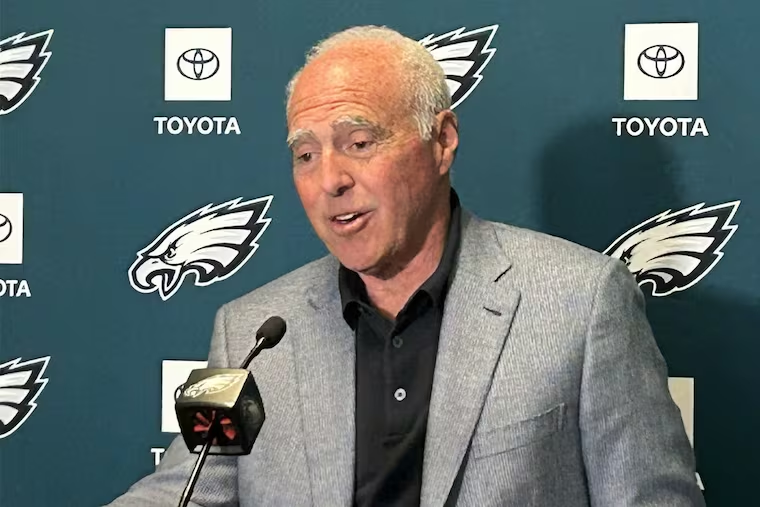
IMAGE: Jeff Mclane/Philadelphia Inquirer