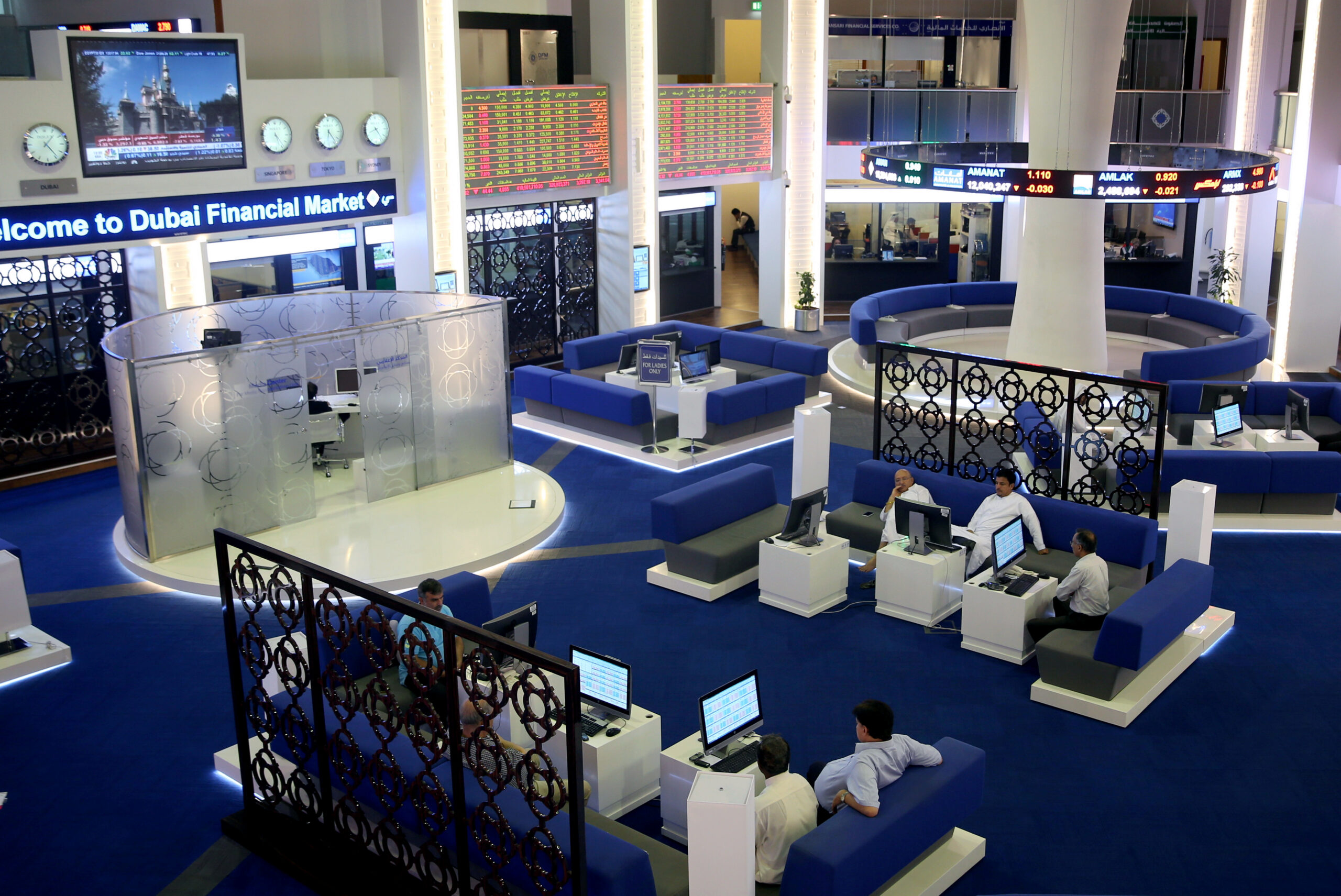
Most stock markets across the Gulf closed lower on Sunday after high-profile talks between U.S. President Donald Trump and Russian President Vladimir Putin ended without progress on the Ukraine conflict, leaving energy markets unsettled and investors cautious.
The much-anticipated Alaska summit failed to deliver either a ceasefire or a roadmap for peace, prolonging geopolitical uncertainty that weighs heavily on oil-dependent economies in the Middle East.
Market Performance Across the Region
- Qatar: The Qatari benchmark fell 0.5%, led by a 1.2% decline in Qatar National Bank, the region’s largest lender.
- Bahrain, Oman, Kuwait: Key indexes also ended lower, reflecting the broader regional risk-off sentiment.
- Saudi Arabia: In contrast, Saudi Arabia’s Tadawul index advanced 0.6%, buoyed by financial and real estate gains. Al Rajhi Bank rose 0.4%, while Dar Al Arkan Real Estate Development surged 5.2%. Oil giant Saudi Aramco added 0.4% following news of a major infrastructure transaction.
Aramco’s $11 Billion Deal
Aramco announced an $11 billion rent-and-leaseback agreement tied to its Jafurah gas processing facilities. The deal, structured with a consortium led by Global Infrastructure Partners (GIP) and backed by BlackRock, underscores Saudi Arabia’s strategy of monetizing energy infrastructure while funding diversification initiatives under Vision 2030.
Egypt Emerges as Outlier
Outside the Gulf, Egypt’s market bucked the trend. The EGX30 index gained 1.1%, supported by a 1.7% rise in Commercial International Bank. Cairo also reported a record primary budget surplus of 629 billion Egyptian pounds ($13 billion) for the 2024–2025 fiscal year, equivalent to 3.6% of GDP. The surplus represents an 80% increase year-on-year, highlighting the government’s fiscal discipline amid broader regional volatility.
Strategic Outlook
The lack of resolution in U.S.–Russia negotiations keeps the geopolitical backdrop fragile for Gulf economies, particularly given their reliance on stable oil revenues. While Saudi Arabia continues to attract global capital through landmark deals like Aramco’s leaseback agreement, other Gulf markets remain highly exposed to investor sentiment tied to global energy and security risks.
Egypt’s fiscal performance stands out as a rare bright spot, signaling resilience and reform momentum in North Africa even as the wider region grapples with uncertainty.
Partner With Us
Want to feature your brand, business, or service on 365247 — Whether you’re looking to sponsor, collaborate, or build presence within our ecosystem, we’d love to explore it with you.
Submit your interest here
IMAGE: Reuters