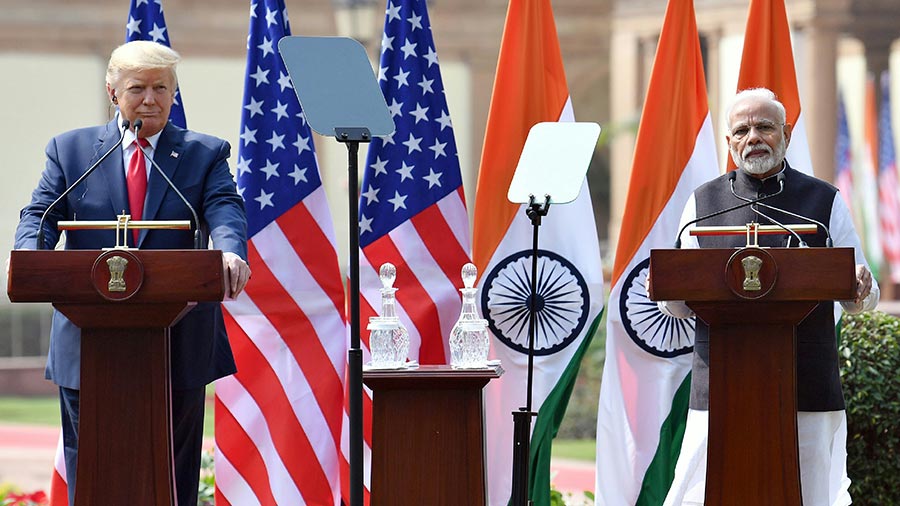
In a sharp escalation of trade rhetoric, former U.S. President Donald Trump announced that a 25% tariff would be imposed on goods imported from India, coupled with what he described as an “unspecified penalty” related to India’s ongoing purchases of Russian oil and defense equipment.
The announcement, posted on Trump’s Truth Social platform, comes as the latest pressure point in a strained negotiation process over a long-pending bilateral trade deal. The proposed measures are expected to take effect from August 1 — a date Trump referred to as the U.S. deadline for finalising a trade agreement with India.
Calling India a “friend” but accusing it of maintaining “one of the highest tariffs in the world,” Trump reiterated longstanding complaints about the lack of reciprocal market access and India’s continued trade with Russia despite Western sanctions.
US-India Trade Talks: A Deal or a Deadlock?
Washington and New Delhi have spent much of 2024 in stop-start trade negotiations. Earlier in the year, Trump had floated tariff hikes as high as 27% on Indian goods, though those were temporarily paused. With the deadline fast approaching, the potential reimposition of tariffs now looms as a key flashpoint.
India’s Ministry of Commerce responded with a cautiously worded statement, affirming the country’s commitment to a “fair, balanced and mutually beneficial” trade arrangement. Officials also emphasised that the government would act decisively to safeguard national interests — especially those of farmers, small businesses, and domestic entrepreneurs.
Meanwhile, U.S. Trade Representative Jamieson Greer acknowledged the complexity of the dialogue, noting that while discussions have been “constructive,” India’s long-standing protectionist policies continue to be a hurdle. He pointed to agriculture and dairy as unresolved areas, with Washington pushing for greater access to India’s tightly regulated farm sector — a red line for New Delhi.
Agriculture: The Political Heart of the Deal
For India, agricultural protections are deeply embedded in both its economic policy and political narrative. With millions of smallholder farmers reliant on government support and trade safeguards, any concessions in this space are viewed domestically as politically risky. Commerce Minister Piyush Goyal recently reiterated India’s position, describing agriculture as a “sensitive” sector, while remaining “optimistic” about the prospects for a deal.
Despite these challenges, Goyal said in a recent interview that India was making “fantastic progress” and expressed hope that negotiations would culminate in a “very consequential partnership” with the United States.
The Broader Picture: Trade Deficit and Global Strategy
The trade imbalance remains a core grievance for Washington. In 2024, bilateral trade reached $190 billion, but the U.S. still ran a $45.8 billion deficit with India — a figure Trump has consistently cited in his campaign-style rhetoric. While India has made some tariff reductions, including on Bourbon whiskey and motorcycles, these have yet to significantly narrow the gap.
Beyond economics, the dispute reflects a deeper geopolitical shift. India’s continued energy and defense engagement with Russia has come under increasing scrutiny from the West amid the ongoing war in Ukraine. Trump’s recent comments signal a desire to link trade access to broader strategic alignment — a potentially controversial strategy that could reset the terms of U.S.-India engagement in 2025 and beyond.
Partner With Us
Want to feature your brand, business, or service on 365247 — Whether you’re looking to sponsor, collaborate, or build presence within our ecosystem, we’d love to explore it with you.
Submit Your Interest Here