The leadership of Apple, one of the most iconic companies in tech history, is under fresh scrutiny. Recent executive exits, underwhelming product announcements, and AI skepticism have triggered speculation around whether Tim Cook’s era as CEO is nearing its end. But some of the world’s most seasoned succession experts are urging caution before drawing conclusions.
While critics point to a sluggish AI response and a lackluster showing at Apple’s Worldwide Developers Conference, industry veterans argue that Apple’s long-term success still hinges on Cook’s steady leadership—at least for now.
Apple’s Recent Struggles: Real or Overblown?
In recent months, Apple has lost two high-profile AI executives to Meta, raising concerns about its positioning in an increasingly AI-driven tech landscape. Add to that a relatively muted response to WWDC announcements and a 16% drop in Apple’s stock in 2025—while rivals Microsoft and Alphabet soar—and it’s understandable why pressure is mounting.
Some investors are calling for a change in leadership, arguing Apple needs a “product-focused” CEO to navigate the AI age, rather than a logistics-minded operator like Cook.
The Case for Stability
However, leadership experts and insiders offer a counter-narrative. Apple, they argue, still holds significant leverage through its platform. Consumers continue to access AI tools via Apple devices, which means the company isn’t losing revenue—even if it hasn’t developed its own breakthrough models yet.
“Apple has never been first to market,” one executive search consultant notes. “Their strength is refining ideas and delivering them in intuitive, beautifully designed ways. That approach still holds value in today’s environment.”
Despite slowing hardware innovation and more powerful competitors, Apple’s design-led philosophy has helped it survive and thrive across multiple product cycles.
What’s Next for Tim Cook?
Now in his 14th year as CEO, Cook turns 65 this November—a milestone that might have previously suggested a transition. But today’s corporate norms, particularly in tech, don’t demand retirement based on age alone.
Insiders suggest Cook may be targeting a longer exit timeline—perhaps around age 68 to 70—especially as he looks to steer Apple through the complexities of AI and global supply chains. That gives the company several years to plan a smooth transition.
Yet Cook’s energy is also a factor. After leading Apple through enormous global growth, pandemic disruptions, and geopolitical tensions, some suggest his motivation may be waning.
Who Might Succeed Him?
Names like John Ternus, Senior VP of Hardware Engineering, and Craig Federighi, Senior VP of Software Engineering, have been floated as potential successors. Both are deeply embedded in Apple’s culture—something the company has historically prioritized.
Apple’s last major outsider CEO, before Steve Jobs’ return, oversaw a period widely seen as misaligned with Apple’s values. That legacy still casts a long shadow. As one executive consultant puts it, “Apple is one of the few companies where the CEO role resembles that of a head of state. Culture matters more than credentials.”
The Bigger Picture: A CEO’s Real Impact
Renowned business historian Richard Tedlow encourages a longer-term view. Evaluating Apple’s leadership through five criteria—customer satisfaction, comeback capability, cultural strength, willingness to learn, and awareness of risk—he finds Apple still scores strongly across the board.
Perhaps most convincingly, Warren Buffett, one of Apple’s largest shareholders, recently praised Cook at the Berkshire Hathaway annual meeting, noting that Cook had made Berkshire “a lot more money” than Buffett himself had.
In Tedlow’s view, if one could choose any CEO in business history to lead Apple today, the answer might not be Steve Jobs—it could very well be Tim Cook.
Closing Thought
While Apple may face challenges, especially in AI, its long-standing philosophy of thoughtful innovation and disciplined leadership remains intact. Betting against that DNA—especially under Tim Cook’s stewardship—may be premature.
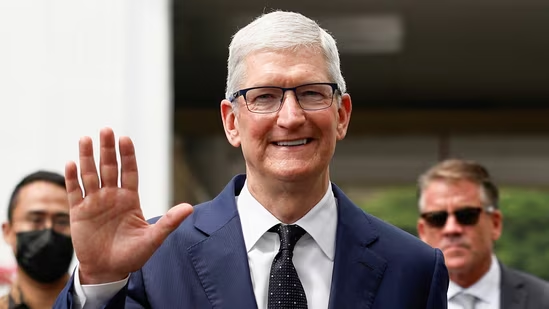
IMAGE: Reuters