Tesla has officially confirmed pricing and availability for its Model Y SUV in India, cementing the EV giant’s long-anticipated foray into the world’s third-largest auto market. The vehicle will be available in two configurations—a standard rear-wheel-drive variant with a claimed 500 km range priced at around ₹60 lakh, and a long-range version with a 622 km range priced at approximately ₹70 lakh. Deliveries are expected to commence by Q4 2025.
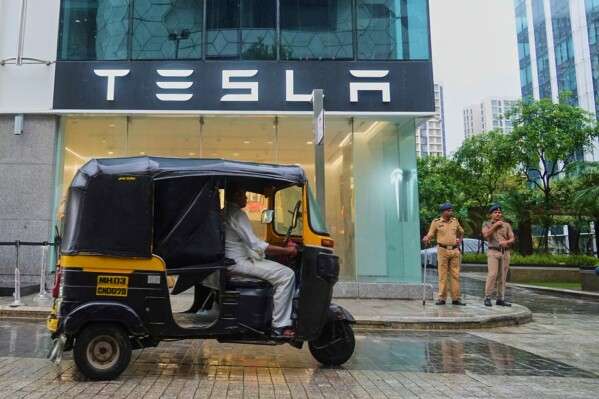
Registrations for the Model Y will be accepted in Delhi, Gurugram, and Mumbai, with Tesla also set to open its first official retail outlet in Mumbai. In addition, buyers will have the option to upgrade to full self-driving capabilities at an extra cost of ₹6 lakh, although activation depends on regulatory approvals and further advancements in autonomous driving.
India Entry: A Long Time Coming
Tesla’s India ambitions date back nearly a decade, with fits and starts largely attributed to the country’s high import duties. At one point, Elon Musk described India’s tariffs as “the highest in the world among large countries.”
The price disparity is notable: the same Model Y retails in the United States for about $38,000 (approximately ₹33 lakh). The significantly higher price in India is largely due to current customs duties on Completely Built Units (CBUs), which can reach up to 100% depending on vehicle specifications.
New EV Import Policy and Government Strategy
To address such concerns and incentivize EV adoption, the Indian government recently unveiled a targeted policy. It permits global EV manufacturers with at least ₹10,000 crore in annual revenue and ₹3,000 crore in fixed assets to import up to 8,000 EVs annually at a reduced 15% import duty over a five-year period, provided they commit a minimum investment of ₹4,150 crore toward setting up domestic manufacturing.
Although this policy was seen as a direct response to Tesla’s long-standing demands, the company has so far shown no signs of committing to local manufacturing, preferring instead to maintain production through its existing international operations, especially in China.
Consumer Impact and Historical Context
Tesla’s announcement comes years after Indian customers placed refundable pre-orders for the Model 3, which was ultimately discontinued. Those reservation fees were refunded earlier this year. Now, with the new showroom in Mumbai’s BKC area and official pricing confirmed, the company appears more serious than ever about Indian market participation.
Still, the high cost of entry and limited availability may constrain mass adoption, at least initially. Experts estimate retail tomato prices could rise by 8.5% due to similar import duties, providing a snapshot of how trade policies affect both prices and demand.
What It Means for India’s EV Landscape
India’s auto industry is projected to double from ₹12.5 lakh crore to ₹24.9 lakh crore by 2030. With over 7% contribution to national GDP and rapid electrification across segments, EVs will be a cornerstone of that growth. Tesla’s entry—even at a premium price point—could accelerate infrastructure development and signal global confidence in India’s EV policy.
However, companies like Mercedes-Benz, Volkswagen-Škoda, Hyundai, and Kia are reportedly more aligned with India’s local manufacturing vision, potentially posing stiff competition to Tesla’s import-only approach.
IMAGE: AP