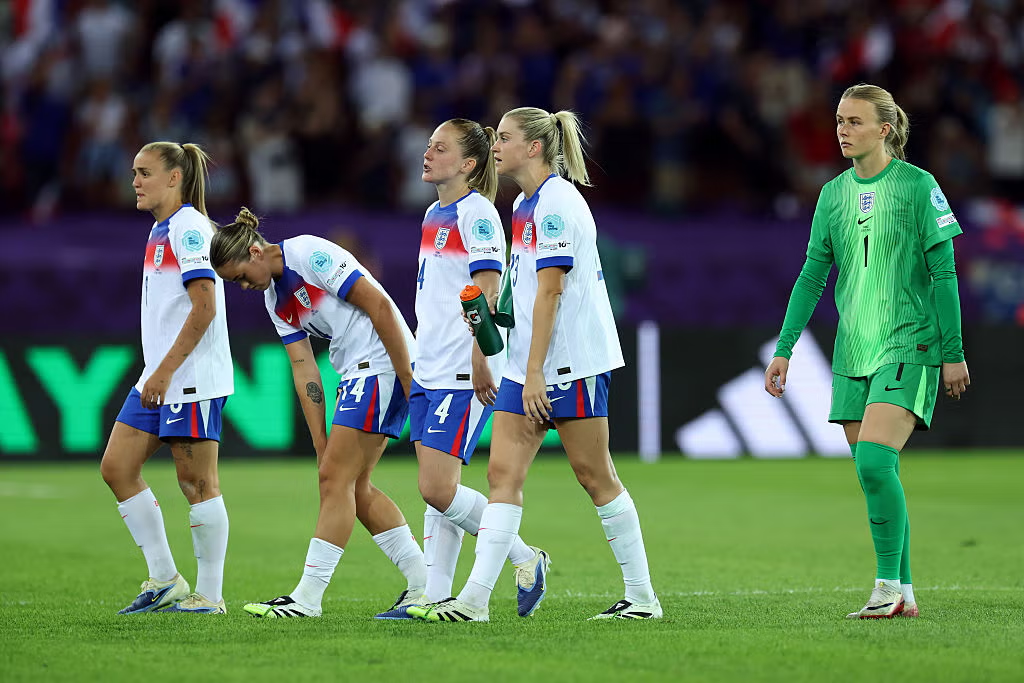
The opening fixture of UEFA Women’s Euro 2025 between France and England showcased more than just a high-stakes clash on the pitch—it also demonstrated the evolving media dynamics of women’s football consumption in Europe. The Group A encounter, which ended in a 2-1 win for France, drew significant TV audiences across both the UK and France, affirming growing demand even in a crowded summer broadcast landscape.
UK Viewership Snapshot
On UK broadcaster ITV1 and ITVX, the match pulled in an average audience of 2.6 million viewers, capturing a 24.4% audience share. Factoring in only the actual match window (excluding studio segments), 3.5 million viewerswatched from kickoff to final whistle. The peak viewership—3.9 million—was recorded around 10pm as England chased a dramatic equalizer.
This was the most-watched program on UK television that Saturday, despite direct competition from Wimbledon (BBC) and the FIFA Club World Cup (Channel 5). However, it fell short of England’s Euro 2022 opener against Austria, which drew 4.5 million viewers. That tournament was held in England, which significantly boosted domestic interest and visibility.
French Audience Trends
On the other side of the Channel, 2.8 million tuned into France Télévisions for the match, achieving a 20.9% audience share. By comparison, France’s 2023 Women’s World Cup group games attracted higher average numbers—peaking at nearly 3.9 million—even though those were morning fixtures due to time zone differences with Australia and New Zealand.
Changing Viewership Patterns in Women’s Football
The match illustrates two key realities:
- Women’s football has secured mainstream broadcast slots but still competes with entrenched events like Wimbledon.
- The availability of multiple matches across free-to-air (FTA) and digital platforms creates fragmented but cumulatively powerful reach.
For reference, England’s Euro 2022 final victory over Germany remains the UK’s most-watched women’s football match to date, peaking at 17.4 million viewers on the BBC, with an additional 5.9 million digital streams. Their 2023 World Cup final loss peaked at 14.8 million across BBC and ITV, averaging 13.3 million overall.
Consulting Analysis: The Viewership Flywheel for Women’s Sports
At 365247 Media, we view these evolving trends as part of a larger strategic flywheel for women’s football:
1. Strategic FTA Broadcasts Build Reach
UEFA’s partnership with the European Broadcasting Union (EBU), ensuring games air on BBC, ITV, France Télévisions and TF1, keeps visibility high among non-core fans—critical for long-term scale.
2. Time-Slot Optimization is Key
Matches airing during prime time (e.g. France vs Wales) outperform early kick-offs like England’s next match vs Netherlands (17:00 UK time). Aligning broadcast windows with prime audience availability can improve conversion.
3. Tournament Location Drives Engagement
Host nation status correlates directly with viewership spikes, as shown in 2022. Broadcasters and federations should factor this into rights and sponsorship planning.
4. Digital + Linear = Total Impact
TV figures alone no longer define value. Cross-platform performance (live streams, catch-up views, highlight clips, TikTok/Instagram traction) are shaping brand value and partner ROI.
Final Word: Commercializing Women’s Football Must Align With Media Trends
As women’s football becomes a year-round property—from club to country—broadcast rights, match scheduling, and platform diversification must be treated as central components of the sport’s growth engine.
The audience is there. Now it’s about serving them with premium access, consistent storytelling, and matchups that resonate with fans across borders.
Join the 365247 Community here
IMAGE: Getty Images