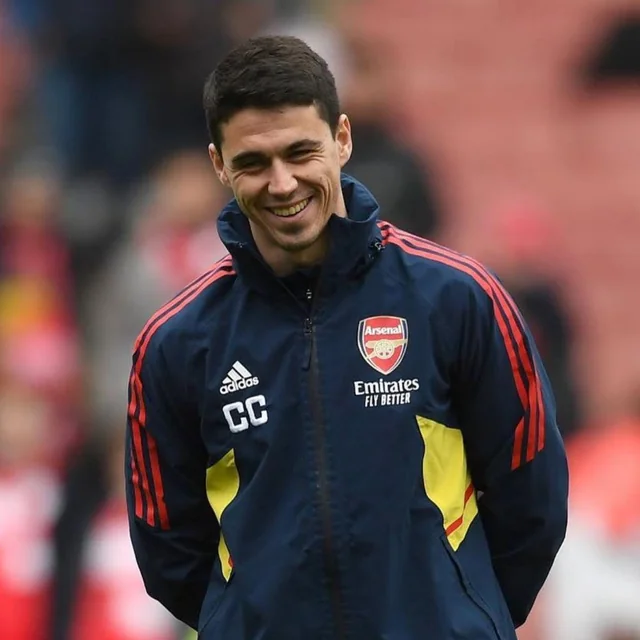
Carlos Cuesta’s rapid ascent in football coaching has drawn wide attention. A Mallorcan native, he began coaching at Santa Catalina Atlético as a teenager and quickly built an international résumé. At 18 he moved to Madrid to study sports science (INEF) while joining Atlético Madrid’s youth staff. Over four years there he progressed from assistant to the under-13s to head coach of the first youth team. Ambitious and inquisitive, Cuesta speaks six languages (Spanish, English, Italian, Portuguese, French and Catalan) and traveled across Europe learning from top clubs and coaches. For example, he spent weeks studying Pep Guardiola’s Manchester City and Diego Simeone’s Atlético, reflecting a “lot of desire, drive and enthusiasm to achieve a goal”. This relentless preparation laid the groundwork for his next steps.
Arsenal Years: Tactical Coach and Player Developer
In August 2020 Cuesta joined Mikel Arteta’s backroom staff at Arsenal, part of a sweeping rebuild. Since then he has worked on the staff for 261 first-team matches, contributing to three straight runner-up finishes in the Premier League. Arteta gave him a unique title – individual development coach – tasking him with improving each player’s tactical and technical game. In practice, Cuesta focuses heavily on tactics and detail: under Arteta he “has grown into one of Arteta’s closest confidants” with a “heavy focus on improving tactical understanding among individual players”. He often works one-on-one with players to refine positioning, pressing triggers, and decision-making.
Arsenal’s style under this staff has been very effective. Data show Arsenal’s offense flourished (91 league goals in 2023‑24) while the team presses aggressively high up the pitch. Tactically, the squad has mastered a synchronized high press and fluid build-up: coaches introduced schemes like the “double press” in the attacking third to force turnovers. OneFootball’s tactical analysis notes that Arsenal’s coordinated pressure “has helped [them] register a notable number of ball recoveries that lead directly to goal-scoring opportunities”. In possession, the back line and goalkeeper play key roles in beating the first press, underlining the emphasis on positional play and building from the back.
Cuesta’s communication is aided by his multilingual skill set. He can convey complex tactical ideas in English, Spanish or Italian, a boon in a cosmopolitan dressing room. Key Fact: In addition to tactics, he specializes in player development – very young talents like Bukayo Saka, William Saliba or Fabio Vieira have benefited from his detailed training sessions. Arsenal players and staff quietly credit him with meticulous preparation; his Mallorcan mentor noted Cuesta’s “meticulousness and knack for getting the best performance out of his players,” saying the team’s tactical and physical preparation “has been greatly aided by the Mallorcan”. In short, he became a crucial link between Arteta’s vision and the players’ execution, helping integrate new signings and academy graduates into the first team.
Reputation and Acclaim
Cuesta’s rise has been noticed widely in the press and among football insiders. English and European media describe him as “one of the world’s best young coaches” and Arteta’s “closest confidant” on the staff. A 2023 Majorcan newspaper even hailed him as “the unsung hero in Arsenal’s title charge,” underscoring the stealthy but essential role he plays. His mentor attests to Cuesta’s “dedication, enthusiasm, knowledge and work,” predicting with confidence that “he will reach the top”.
Among clubs, interest in Cuesta has surged. Last season he was linked with England’s Norwich City and several European sides; notably, Italian media reported that AC Milan sporting director Moncada considered him as a candidate for their youth setup, lauding him as “brilliant” despite his youth. Fabrizio Romano and Sky Italia confirmed Parma had brought Cuesta in as their top managerial target in 2025. That move represents faith in his modern approach: Football Italia called Parma’s choice “a particularly remarkable decision” given his age.
Quick Facts Recap: Cuesta has been Arsenal’s assistant in 261 games (three PL runners-up), studied at Spain’s top sports science institute, and gained accolades for his work ethic (e.g. “the more I work, the luckier I will be”). He is widely respected by players and analysts for his tactical acumen and training intensity, even if he has kept a low public profile. In sum, he enjoys a reputation as a tireless, detail-oriented coach who can communicate with and elevate young players.
Parma Appointment: New Challenges and Objectives
Parma Calcio 1913 (the Krause-owned Italian club) has turned to Cuesta as it rebuilds in Serie A. Appointed in June 2025 as head coach, he replaces Cristian Chivu (who left mid-season for Inter Milan). At 29 he will be the youngest boss in Italy’s top flight in nearly 100 years. Reports emphasize that Parma pursued foreign managers after Chivu’s exit – even holding talks with Daniele De Rossi – before settling on Cuesta. In that context, hiring Cuesta signals an embrace of fresh, innovative methods.
Parma return to the Serie A spotlight after a three-year absence. They secured promotion in 2024 and survived their first year back by finishing 16th. The squad’s offensive output was modest – their top scorers had only five league goals apiece – and budget constraints mean Cuesta will face pressure to punch above the club’s weight. His objectives are clear: stabilize Parma in mid-table, improve defensive organization (the team conceded 34 goals in 2024–25), and develop young or underused players into reliable contributors. Press reports suggest he was lured by “the challenge of being the youngest manager in Europe’s top five leagues and returning Parma to the top half of Serie A”. Achieving that will require tactical clarity and buy-in; fortunately, Cuesta’s track record at Arsenal — communicating complex plans in multiple languages and extracting disciplined performances — bodes well for connecting with Parma’s squad.
Coaching Philosophy and Comparative Approach
Cuesta epitomizes a new generation of analytical, detail-focused coaches. His philosophy marries rigorous organization with adaptive creativity. Mentors describe him as “dedicated to the technical side of football,” poring over video analysis daily and specializing in exploiting opponents’ weak points. He is deeply influenced by the coaches he has studied: taking from Guardiola a high-press, possession-minded approach, and from Simeone a tenacious defensive structure. On the training ground he’s known for intense work, often quipping “the more I work, the luckier I will be,” reflecting a belief that preparation creates opportunity.
In practice, Cuesta emphasizes positional discipline and flexibility. At Arsenal he helped implement a hybrid 4-3-3/4-2-3-1 system that can switch during games, creating numerical advantages in key areas. His teams press with coordination and timing (the “double press” vs. top opponents) and are drilled in transitional movement. He also values set pieces – Arsenal have become lethal on corners under Arteta’s staff – and will likely work with Parma’s coaches to tighten routines. In all, his style is systematic and evolving: he studies new trends rigorously and adapts his tactics to the players at hand. This is reminiscent of other young elite coaches who blend innovation with traditional preparation; Cuesta’s edge is simply doing it at an earlier age.
Compared to other modern managers, Cuesta stands out for his youth and academic approach. While he lacks the playing pedigree of some peers, he compensates with a master’s-level understanding of sports science and tactical analysis. In this, he is more akin to data-driven coaches like Enzo Maresca or Xabi Alonso (the latter just starting out), but Cuesta has already gained top-flight experience. Observers note that if he quickly impacts Parma’s style and results, he could be mentioned alongside a new wave of Spanish coaches (such as Julen Lopetegui or Marcelino) who emphasize structured possession and pressing. For now, he brings modern methodologies: detailed video sessions, individualized player coaching, and an ethos of continuous learning.
Looking ahead, success at Parma would significantly boost Cuesta’s standing. Italian pundits already view his hiring as a bold long-term project. If he can lift Parma toward the upper half of Serie A (projected objective) or achieve a domestic cup run, he will prove himself capable at senior level. That could open doors to bigger jobs – perhaps top-10 clubs in major leagues who value young, adaptable coaches. As his mentor predicted, “Carlos has dedication and knowledge… I have no doubt that he will reach the top”. In interviews Cuesta remains modest, but experts agree that a strong debut season in Italy would mark him as a future candidate for even more prestigious roles.
Join the 365247 Community here.
IMAGE: Getty Images