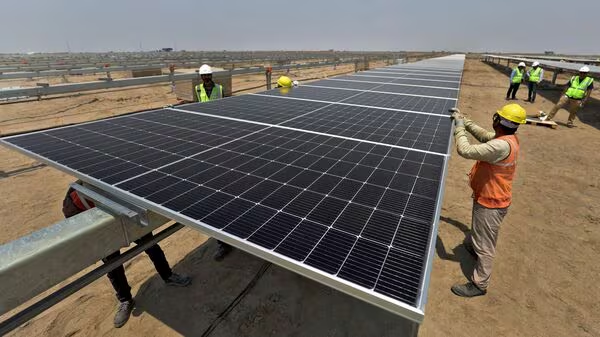
A major move is brewing in India’s renewable energy sector. The joint venture between Ayala Corporation’s ACEN and UPC Renewables is preparing to offload up to 74% equity in three large-scale clean energy projects across India. Valued at an enterprise level of around $600 million, the deal reflects both global interest in India’s green energy potential and a strategic shift in the JV’s growth model.
Inside the Deal
The upcoming sale spans 1 gigawatt (GW) worth of renewable capacity, spread across solar, wind, and hybrid assets:
- 420 MW solar project in Rajasthan’s Barmer region
- 100 MW wind farm in Karnataka
- 520 MW wind-solar hybrid project targeted for commissioning by 2027
Global advisory firm EY is reportedly overseeing the transaction, with the equity component estimated at approximately $200 million. The process will follow a conventional investment path — starting with NDAs and due diligence, before shortlisting bidders for final offers.
ACEN–UPC in India: Building Big
While ACEN and UPC have an established global presence — with a combined 17 GW of operational and pipeline assets — their India-focused venture, UPC Renewables India, currently operates 630 MW. This includes projects like the 420 MW Masaya Solar in Madhya Pradesh and 140 MW Sitara Solar in Rajasthan.
According to UPC Renewables India CEO Alok Nigam, the JV has already broken ground on two of the new projects and is aiming to deliver over 1 GW of renewable capacity in the next 24 months. The ambition: support India’s clean energy transition while tapping into the country’s fast-growing energy demand.
India’s Green Ambitions: Growth Meets Growing Pains
India is chasing an ambitious target of 500 GW of renewable capacity by 2030 — and the numbers show serious intent. As of today, India has already crossed 226 GW in renewables, with 111 GW solar and 51 GW wind in place. Yet the road ahead is anything but smooth.
Demand Up, But Storage & Distribution Lag
- The Central Electricity Authority (CEA) expects India’s peak power demand to hit 270 GW in 2025.
- Power generation during daylight solar hours has recently crashed to ₹0/unit in spot pricing, while evening peak prices have surged — underscoring the urgency for energy storage systems (ESS).
- Despite over 150 GWh worth of storage tenders, very few projects have reached execution.
Transmission Bottlenecks
While solar and wind capacity is scaling fast, transmission infrastructure is lagging. According to CRISIL and S&P, upcoming projects are at risk of curtailment due to delays in grid connectivity, regulatory approvals, and equipment shortages. India plans to spend ₹1 lakh crore across this and next fiscal to expand the grid, but timely execution is critical.
Trillion-Dollar Opportunity
India’s green energy transition is set to cost big. To reach its 2070 net-zero goal, the country will need to deploy $1.3 trillion in clean power investments by 2035. In 2024 alone, renewables attracted $33 billion, with projections for 12% growth in 2025, according to research by Kotak Institutional Equities.
Yet with nearly 30 GW of commissioned renewable capacity still awaiting buyers, challenges around power purchase agreements (PPAs), price volatility, and integration remain unresolved.
A Critical Inflection Point
As ACEN and UPC explore strategic divestment from their India pipeline, the move highlights a growing trend — capital recycling and JV optimization in the energy sector. With the right regulatory support, storage integration, and transmission expansion, India could transform from a high-potential market to a global clean energy hub.
But as always in infrastructure-heavy sectors, execution is everything.
Join the 365247 Community here.
IMAGE: Reuters